
Leaky pipe joints cause major headaches and costly repairs underground. This undermines project timelines and your reputation. HDPE fusion creates a seamless, permanent system you can trust completely.
Yes, you can and should fuse HDPE. The process uses heat and pressure to melt and join pipes and fittings into a single, continuous piece. This creates a monolithic, leak-proof system that is just as strong as the pipe itself, eliminating weak points for good.
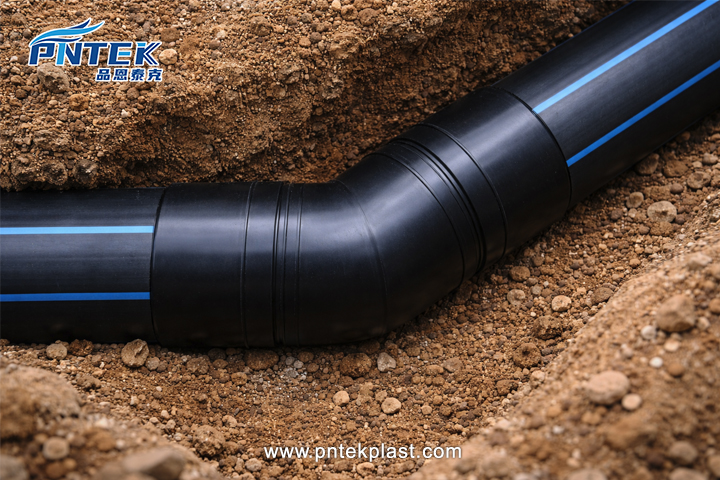
I’ve been in the plastic piping industry for nearly two decades, and I can tell you that the joint is always the most critical part of any system. A pipe is only as strong as its weakest connection. Traditional systems rely on gaskets or chemical glues, which can degrade over time. This is a huge risk, especially for infrastructure that needs to last for decades.
This is where High-Density Polyethylene (HDPE) changes the game. Its unique properties allow for fusion welding, which isn’t just joining two pieces—it’s making them one. Let’s look at exactly how this works and what you need to know to ensure a successful, leak-free project every time.
What fittings to use for HDPE?
Choosing the wrong fittings can compromise your entire HDPE pipeline. Mismatched components lead to weak points and potential system failure. Understanding fusion and mechanical fittings ensures you select the right one.
For HDPE, you mainly use fusion fittings for permanent, welded joints, which include butt fusion, socket fusion types, and electrofusion types. You can also use mechanical fittings like compression or flange adapters for transitions to other materials or for areas where you might need to take it apart later.
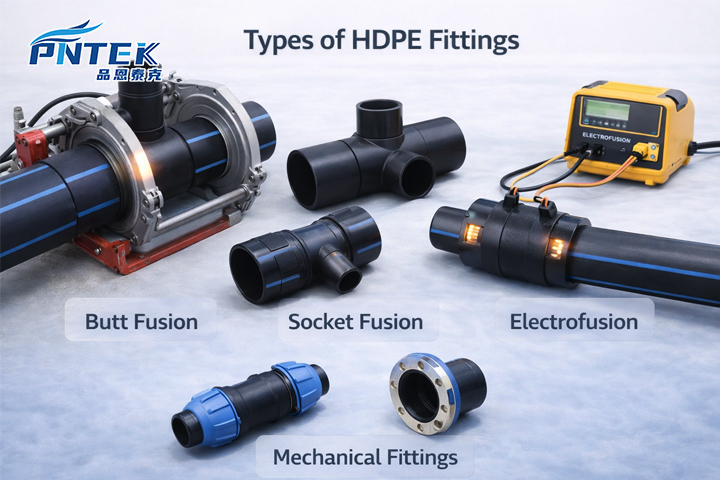
The right fitting depends entirely on the job. Over the years, I’ve worked with many procurement managers like Arief in Indonesia, who manage everything from municipal water lines to mining operations. For large-diameter pipes, like those in a city’s main water supply, butt fusion is the standard. For smaller lines, socket fusion is often faster and more practical. The key is matching the fitting type to the pipe size and pressure requirements. As a manufacturer, we produce all these types, and our goal is to help you select the most reliable and cost-effective option for your specific project.
Comparing HDPE Fitting Types
| Fitting Type | Joining Method | Common Sizes | Best Use Case |
|---|---|---|---|
| Butt Fusion | Heat and pressure on pipe ends | 63mm and up | Large-diameter mains (water, gas) |
| Socket Fusion | Heat on pipe OD and fitting ID | 20mm to 110mm | Smaller-diameter pipes, tight spaces |
| Electrofusion | Internal heating coil in fitting | 20mm and up | Repairs, tie-ins, difficult conditions |
| Mechanical | Compression, flanges | All sizes | Transitions to other materials, temporary lines |
What is fusion fitting?
You often hear the term “fusion fitting” but might not fully grasp what makes it so different. This uncertainty can make you hesitate to adopt a superior technology. Fusion fitting is simply a method to weld plastic pipes together into one solid piece.
A fusion fitting is a specially designed HDPE component used to join pipes through heat welding. Instead of using threads or gaskets, it relies on controlled heat to melt the material of both the pipe and the fitting. When they cool, they form a single, continuous piece of plastic.
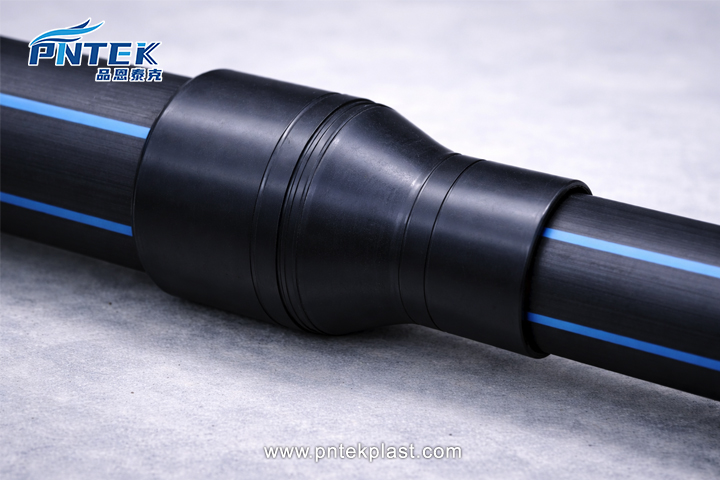
The result of fusion is what we call a “monolithic” system. This means the pipeline has no mechanical joints. It’s one continuous, sealed tube from end to end. I’ve seen projects in Southeast Asia struggle with leaks from traditional joints, especially where the ground shifts or settles. A fusion joint completely eliminates this risk. It’s not just a connection; it’s a permanent continuation of the pipe itself. For an engineer focused on long-term performance, this is the most important benefit. It removes the biggest point of failure found in other piping systems.
Why Fusion Creates a Superior Joint
| Feature | Fusion Joint (HDPE) | Mechanical Joint (e.g., PVC/Metal) |
|---|---|---|
| Sealing Mechanism | Materials are fused into one piece | Relies on a gasket or thread sealant |
| Joint Strength | As strong as or stronger than the pipe | A potential weak point in the system |
| Long-Term Reliability | Permanent, does not degrade | Gaskets can wear out, bolts can loosen |
| Leak Risk | Virtually zero | A constant risk, especially with pressure changes |
What is a socket fuse?
You need to connect smaller diameter pipes reliably and quickly on a busy site. Butt fusion can be slow and difficult for small pipes. Socket fusion offers a fast, strong, and straightforward solution for these situations.
Socket fusion is a heat-welding technique for smaller HDPE pipes, usually up to 110mm (or 4 inches). It uses a heating tool with matching male and female heads. These heads simultaneously heat the outside of the pipe and the inside of the fitting’s socket before they are pushed together.
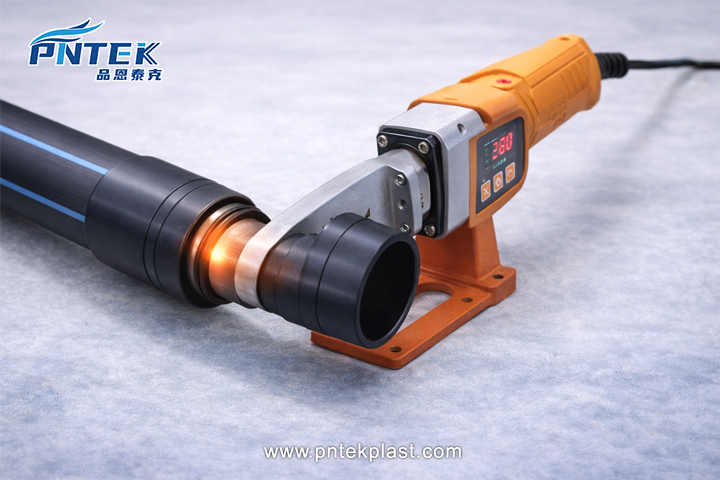
The process is simple but requires precision. We manufacture our socket fusion fittings with very tight tolerances for this reason. I remember a case where a contractor was having joint failures. We discovered they were using low-quality fittings with inconsistent socket depths. This prevented a proper weld and created weak points. For a detail-oriented manager, ensuring your fittings meet international standards is critical. This is why we control our production so carefully—the process starts with a perfectly made fitting. A proper socket fusion joint is fast to make on-site and incredibly strong, making it ideal for residential water lines and industrial plumbing.
The Socket Fusion Process in 4 Steps
| Step | Action | Key Detail |
|---|---|---|
| 1. Preparation | Cut the pipe square, clean it, and mark the insertion depth. | A clean, square cut is essential for full surface contact. |
| 2. Heating | Simultaneously insert the pipe and fitting onto the heating tool. | Hold for the specified time without twisting; let heat do the work. |
| 3. Insertion & Joining | Quickly remove both and push the pipe into the fitting up to the mark. | This must be done in one fluid motion. Do not twist. |
| 4. Cooling | Hold the joint steady under pressure for the recommended time. | The joint gains its strength during this cooling period. Do not rush it. |
How does HDPE fusion work?
The science behind HDPE fusion might seem complex or mysterious. Without understanding the basic principle, it can be hard to fully trust the process. It simply works by heating HDPE to its melting point, allowing the materials to mix and form a permanent bond.
HDPE fusion works by applying a controlled temperature (around 220°C or 428°F) to the surfaces you want to join. This turns the solid polyethylene into a molten state. When you press the molten surfaces together and let them cool, the polymer chains from each piece intermingle and fuse into one solid mass.
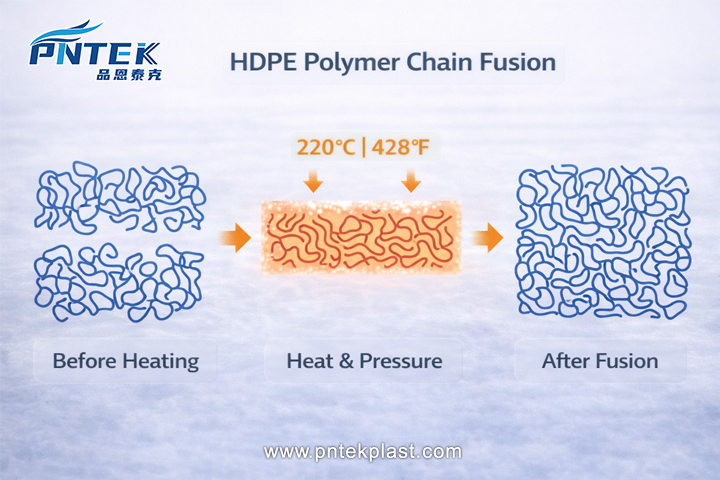
From a manufacturing standpoint, the quality of the raw material is everything. At Pntek, we only use 100% virgin PE100 resin. This ensures the material has a consistent melting point and flow behavior, which is critical for a predictable, strong weld. You cannot get a reliable fusion with recycled materials or inconsistent resins. For someone with an engineering background, this is a key takeaway. The integrity of that final joint in the field truly begins here in our factory, with the quality of the raw material we choose. A perfect weld depends on four things: the right temperature, the right pressure, the right timing, and clean surfaces.
The Science of a Perfect Weld
| Factor | Why It’s Critical | My Manufacturing Tip |
|---|---|---|
| Temperature | Too hot degrades the material; too cold prevents a full fusion. | Use calibrated equipment and always follow the machine’s guidelines. |
| Pressure | Proper pressure ensures the molten materials fully mix together. | The machine applies this pressure. Don’t add manual force. |
| Time | Heating and cooling times allow polymer chains to flow and then lock in place. | Never rush the cooling time. This is when the joint gains its full strength. |
| Cleanliness | Dirt or oils will prevent the materials from fusing properly, creating a weak joint. | Always clean the pipe and fitting surfaces immediately before heating. |
Conclusion
HDPE fusion is not just possible; it’s the superior method for joining pipes. It creates strong, permanent, leak-proof joints, ensuring long-term reliability for your most critical infrastructure projects.
Post time: Mar-09-2026


