Your valve seals are failing in the tropical heat and sun. This leads to costly leaks, system downtime, and unhappy clients who question your product’s quality and your reputation.
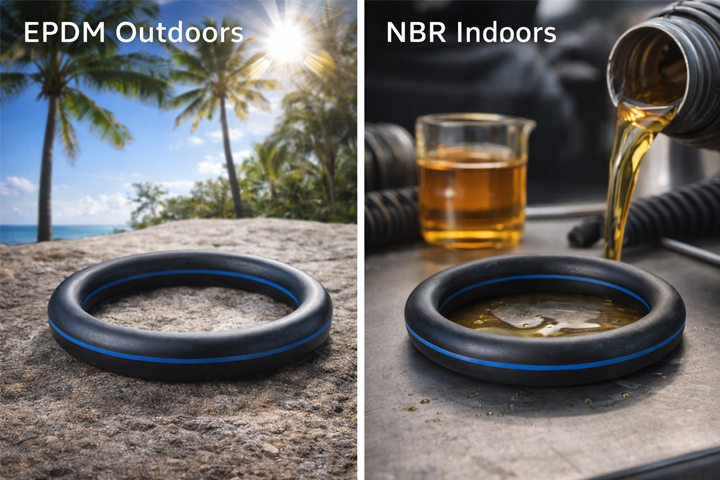
For tropical climates, EPDM is superior for any water application exposed to sunlight and weather due to its excellent UV and ozone resistance. Use NBR only for indoor applications involving oils, where it is shielded from the sun.
I was chatting with my partner Budi from Indonesia about a persistent issue one of his customers faced. They were running a large aquaculture farm where hundreds of our valves were installed outdoors. After just six months, many started to leak. The valves were fine, but the standard NBR seals inside were cracking and becoming brittle. This is a classic problem in tropical climates. The combination of intense sun, high heat, and humidity was destroying the rubber. We helped them switch to valves with our EPDM seals, and the problem vanished. This experience perfectly shows why material choice is so critical in hot environments.
Which is really better for the tropics, NBR or EPDM?
NBR seals are less expensive, which looks great on a quote. But will this saving backfire when the seals degrade quickly under the intense tropical sun and heat?
For tropical water systems, EPDM is definitively better. Its chemical structure is built to resist UV, ozone, and heat. NBR’s poor weather resistance makes it a high-risk choice for any outdoor use in a tropical region.
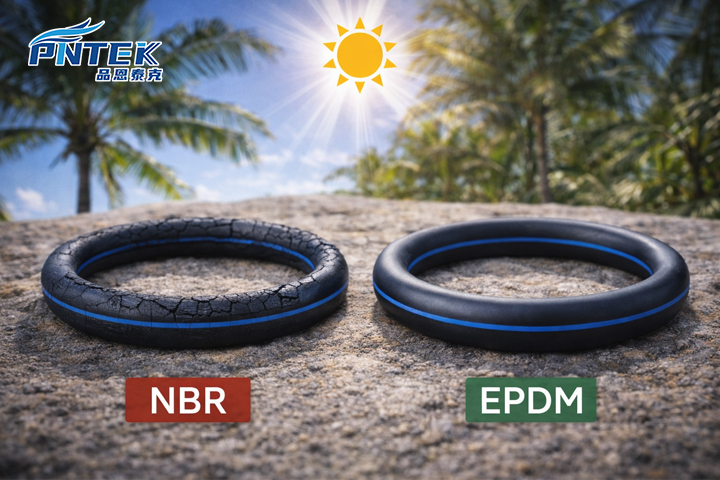
This is not a matter of opinion; it is a matter of chemistry. EPDM has what is called a saturated polymer backbone. This stable structure is naturally resistant to attack from UV radiation and ozone, two things that are abundant in a sunny, tropical climate. NBR, on the other hand, has an unsaturated backbone with double bonds. These double bonds are weak points that are easily broken by UV rays, causing the material to become brittle and crack. In a place like Indonesia or Vietnam, an outdoor irrigation or water treatment system faces relentless sun exposure. An NBR seal might fail in under a year. An EPDM seal in the same environment can last for many years. The slightly higher initial cost of EPDM is a small price to pay for long-term reliability and avoiding system failure. The cost-benefit analysis overwhelmingly favors EPDM for any outdoor application.
What are the disadvantages of EPDM rubber?
EPDM seems perfect for outdoor water lines. But what happens if the fluid contains oils or hydrocarbon-based chemicals? A wrong application can cause the seal to fail completely.
The main disadvantage of EPDM is its poor resistance to petroleum-based fluids like oils, greases, and many solvents. Contact with these substances will cause the EPDM seal to swell, soften, and lose its sealing ability.
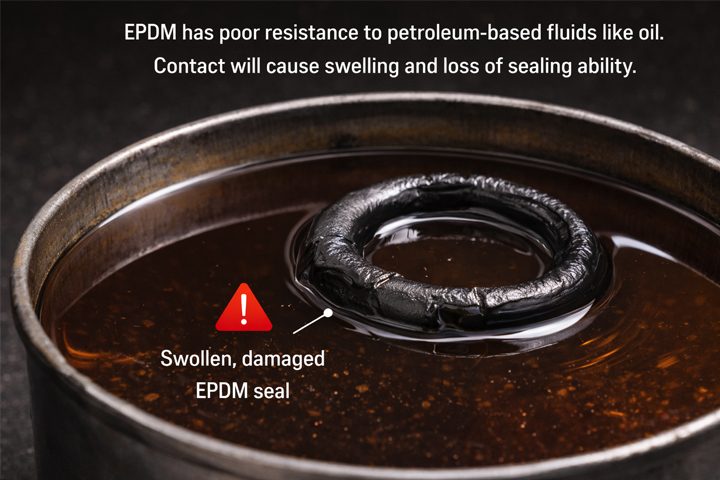
The rule in chemistry is “like dissolves like.” EPDM is a non-polar material, and so are hydrocarbon oils. When they come into contact, the EPDM absorbs the oil, causing it to swell up like a sponge. This swelling dramatically weakens the material and destroys its ability to hold a seal under pressure. This makes it completely unsuitable for applications involving fuel lines, hydraulic systems, or many industrial chemical processes. The other disadvantage is cost. EPDM is a more advanced polymer, so its production cost is higher than NBR. This is why it is often seen as a premium option. However, it’s crucial to view this cost in the context of the application. For the right job (water, weather, heat), the higher initial price buys you years of trouble-free service, making its total cost of ownership much lower.
What are the main disadvantages of NBR?
NBR is the low-cost standard for many applications. But its poor resistance to weather can lead to cracking and failure, a major risk in any tropical outdoor environment.
NBR’s biggest disadvantage is its very poor resistance to sunlight (UV), ozone, and general weathering. This causes it to become hard and brittle. It also has a lower maximum temperature rating than EPDM, accelerating its aging in hot climates.
For a market like Budi’s in Indonesia, this is the most important factor to understand. The combination of intense, year-round sunlight and high ambient heat is the worst possible environment for NBR. The UV radiation attacks the polymer chains directly, while the heat accelerates this aging process. This causes the material to lose its flexibility, which is its primary job. A brittle seal cannot compress to stop a leak; it simply cracks under pressure. This is why we see so many failures of standard NBR-sealed valves in tropical agriculture and outdoor plumbing. This weakness also applies to ozone. Ozone is generated naturally by sunlight and is also used in some advanced water purification systems. Even small concentrations of ozone will rapidly degrade NBR. In short, using NBR for any outdoor application in the tropics is gambling with your product’s reliability and your reputation.
Is NBR rubber truly heat resistant for the tropics?
You see a temperature rating for NBR rubber on a spec sheet. But is that rating reliable in a real-world tropical environment where ambient temperatures are already very high?
NBR is moderately heat resistant, typically up to 120°C (248°F). However, this limit decreases with continuous exposure. The combination of high ambient heat and operational heat in the tropics can push NBR to its limits, causing premature failure.
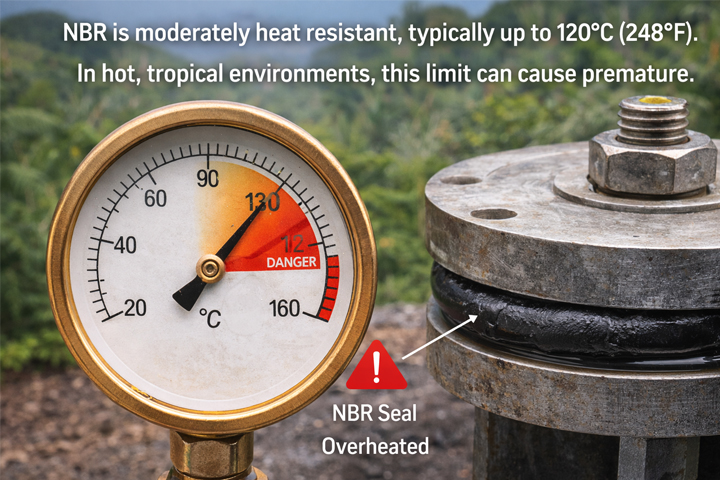
A specification sheet can be misleading if not read carefully. That 120°C rating is often for intermittent, not constant, heat. In a tropical climate, the ambient temperature might already be 35°C. A valve sitting in direct sun on a rooftop can easily reach surface temperatures of 70°C or more, even before hot water flows through it. This constant thermal load puts the NBR material under permanent stress. EPDM, with its typical rating of 150°C, has a much larger safety margin. It can easily handle the combined stress of high ambient heat and hot process fluids without degrading. This superior thermal stability is another key reason we strongly recommend EPDM for long-term performance in hot climates.
Tropical Climate Performance Summary
| Feature | NBR (Nitrile) | EPDM | Tropical Application Recommendation |
|---|---|---|---|
| Sunlight (UV) Resistance | Poor | Excellent | EPDM is mandatory for outdoor use. |
| Heat Resistance | Fair (up to 120°C) | Excellent (up to 150°C) | EPDM offers a much better safety margin. |
| Aging in Heat & Sun | Fast | Slow | EPDM provides far superior longevity. |
| Oil & Fuel Resistance | Excellent | Poor | NBR is the only choice for these fluids. |
| Cost | Lower | Higher | EPDM has a lower total cost of ownership. |
Conclusion
For tropical water applications, EPDM’s UV and heat resistance is essential. Reserve NBR only for indoor, protected systems that handle oils. The right choice ensures long-term, reliable performance.
Post time: Jan-28-2026