
You’re looking at pipe specifications and see codes like PE80 and PE100. This technical jargon is confusing, and choosing the wrong type can compromise the long-term integrity of your project.
PE100 means the pipe is made from the latest generation of High-Density Polyethylene (HDPE). The “100″ signifies a Minimum Required Strength (MRS) of 10.0 MPa. This makes it a stronger, more durable material that allows for thinner pipe walls at the same pressure rating.
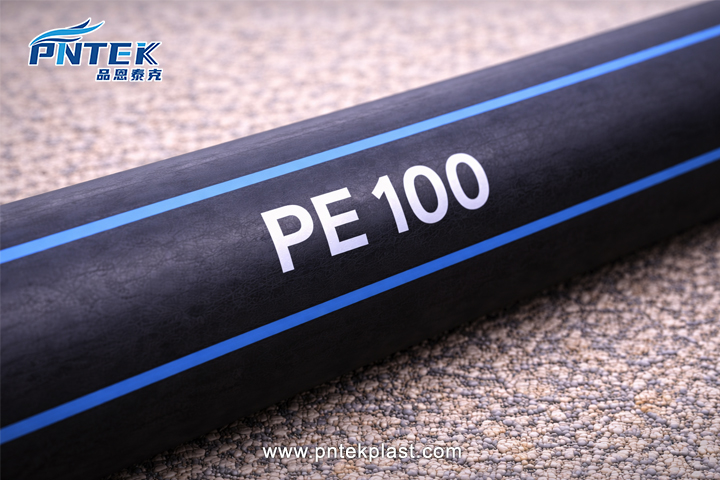
When I talk with purchasing managers like Budi, these material grades are a frequent topic. It’s easy to see them as just numbers, but “PE100″ represents decades of material science advancement. It’s a promise of strength, reliability, and long-term performance. Understanding what this simple code means is the key to making a smart purchasing decision that ensures the success of your water management systems for years to come. Let’s break down what this grade really means for your projects.
Is PE100 better than PVC?
PVC is a familiar material and often has a lower upfront cost. This makes it tempting to choose, but its rigidity and jointing method can lead to future problems and higher overall costs.
For buried water mains, PE100 is generally better. Its flexibility, higher impact resistance, and leak-proof fused joints offer superior long-term reliability. PVC’s solvent-welded or gasketed joints are often the weakest point in the system, a problem that fusion welding completely eliminates.
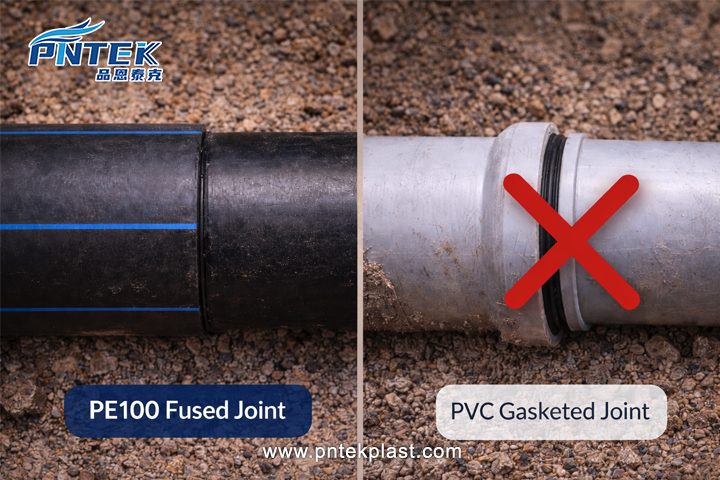
While both materials are good for certain applications, their fundamental differences become clear in demanding situations. The single greatest advantage of PE100 is the jointing method. When you heat fuse an HDPE pipe, the joint becomes a single, solid piece of plastic, as strong as the pipe itself. It simply cannot leak. PVC joints, relying on solvent cement or rubber gaskets, introduce a potential point of failure. Over time, ground movement and pressure changes can compromise these joints. PE100′s flexibility also allows for trenchless installation, which can drastically reduce construction time and cost, a major benefit in crowded urban areas. PVC, being rigid, requires traditional open-trench digging, which is more disruptive and expensive.
| Feature | PE100 (HDPE) | PVC |
|---|---|---|
| Jointing Method | Heat Fusion (Butt or Socket) | Solvent Cement or Gasket |
| Joint Reliability | Monolithic (as strong as the pipe) | Potential weak point |
| Flexibility | Highly flexible, can be coiled | Rigid |
| Impact Resistance | Excellent, does not shatter | Good, but can be brittle in cold |
| Installation | Ideal for trenchless methods | Requires traditional trenching |
What is the difference between PE 80 and PE100?
You see two quotes, one for PE80 pipe and one for PE100. The numbers seem close, but choosing the lower grade to save a little money could mean installing a weaker pipe.
The number refers to the Minimum Required Strength (MRS) after 50 years. PE100 has an MRS of 10.0 MPa, while PE80 is 8.0 MPa. This 25% increase in strength allows PE100 pipes to have thinner walls for the same pressure rating.
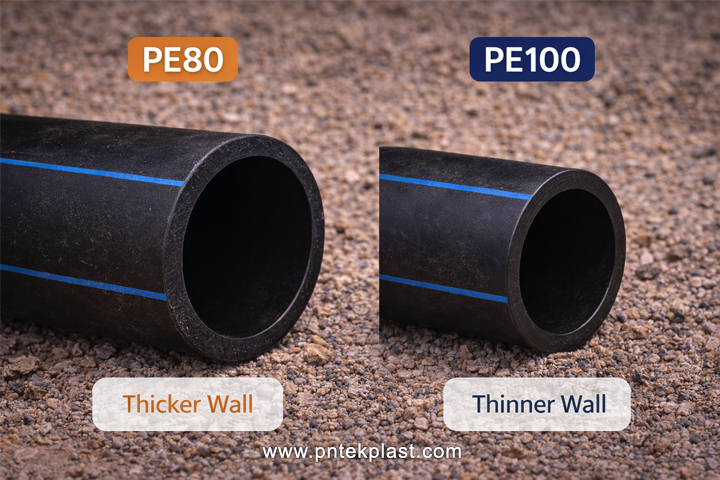
The Minimum Required Strength (MRS) is a value that describes the long-term strength of the material. Scientists determine it by putting the pipe under pressure and measuring how long it takes to fail, then using that data to predict its strength over a 50-year service life. The higher the MRS, the stronger the material.
This 25% strength advantage of PE100 over PE80 gives you two major benefits. First, for a pipe of the same thickness, PE100 can handle a higher pressure. Second, and more importantly for saving money, you can use a PE100 pipe with a thinner wall to achieve the same pressure rating as a thicker PE80 pipe. A thinner wall means less raw material is used, which makes the pipe lighter and more cost-effective. A lighter pipe is cheaper to transport and easier to handle on-site. The thinner wall also creates a larger internal diameter, which improves water flow and reduces pumping costs over the life of the system.
Which is better, HDPE or PE?
The terms PE and HDPE are often used in the same conversation. This can be confusing, making you think you are comparing two completely different materials when you are not.
This is a trick question, as HDPE (High-Density Polyethylene) is a specific type of PE (Polyethylene). PE is the broad family name. For pressure pipes for water and gas, HDPE is the correct and superior choice due to its strength and durability.
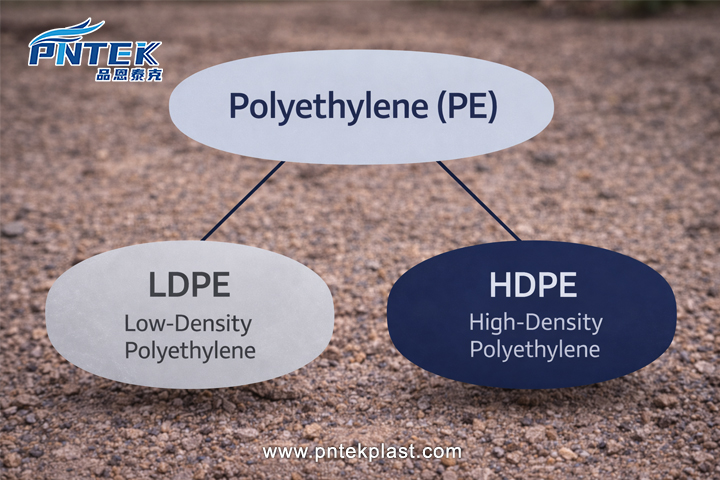
Think of “Polyethylene” (PE) as the family name for a whole group of plastics. Within this family, there are several different types based on their molecular density, which determines their physical properties.
- PE (Polyethylene): The overall category.
- LDPE (Low-Density Polyethylene): Very flexible, used for things like plastic bags and films. It is not suitable for pressure pipes.
- HDPE (High-Density Polyethylene): Much stronger, more rigid, and tougher. This is the standard material for pressure pipes used in water supply, gas distribution, and industrial applications.
So, when we talk about PE pipe in the context of water management, we are almost always talking about HDPE pipe. The grades we discussed earlier, PE80 and PE100, are specific performance classifications of HDPE resin. So, the question isn’t “HDPE or PE?” but rather, “Which grade of HDPE is right for my project?”. For any new installation, PE100 grade HDPE is the best choice.
Can you weld PE80 to PE100?
You need to repair an old water line made of PE80. Your new stock is all PE100. A failed weld between the two materials could cause a major service disruption.
Yes, you can weld PE80 directly to PE100. Because they are both from the polyethylene family, their plastics will fuse together. However, you must use the welding parameters for the lower-grade PE80, and the joint will only be as strong as a PE80 joint.
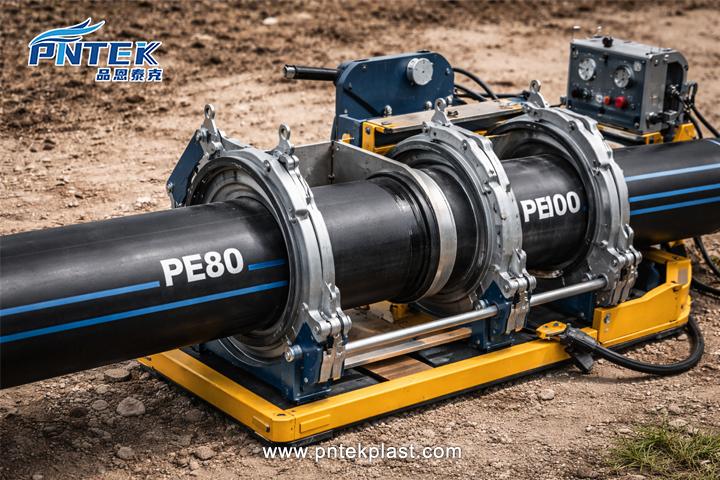
This is a very important question for maintenance and repair work. The ability to join different grades is a huge advantage of HDPE. Because both PE80 and PE100 are made from the same base polymer, their molecular structures are compatible and will fuse together during heat welding to create a strong, permanent bond.
However, there is one critical rule you must follow: always use the welding parameters (temperature, time, and pressure) specified for the lower-grade material. PE80 and PE100 can have slightly different melting behaviors, and using the settings for PE100 could overheat or damage the PE80 pipe end, resulting in a weak joint. The second thing to remember is that the system is only as strong as its weakest link. The welded joint and the entire pipeline section will have a pressure rating and performance characteristic of the PE80 pipe, not the PE100. While for new projects we always recommend PE100, this compatibility is perfect for extending or repairing older infrastructure.
Conclusion
PE100 is not just a code; it is a grade of high-performance HDPE. Its superior strength and reliability make it the modern standard for building secure, long-lasting water pipelines.
Post time: Feb-10-2026


