
Choosing the right pipe material is critical for long-term project success. You worry that complex terms like “PE100″ hide risks. PE100 is simply the modern standard for high-strength plastic pipes.
A PE100 pipe is a pressure pipe made from a high-performance grade of High-Density Polyethylene (HDPE). The “100″ signifies its certified Minimum Required Strength (MRS) of 10 MPa, guaranteeing its ability to handle high pressure for over 50 years, making it ideal for critical infrastructure.
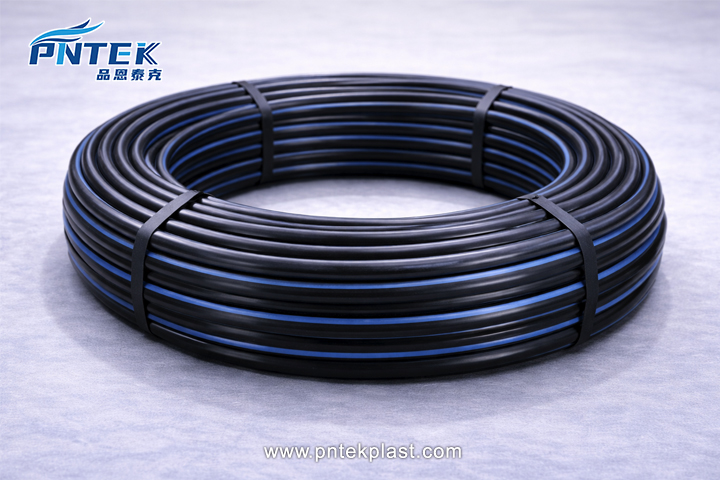
As a manufacturer of piping systems for nearly two decades, I’ve built my business on one principle: reliability starts with the raw material. PE100 is not just a random name; it is an international standard that we and our customers depend on. For professionals like Arief, a senior procurement manager in Indonesia, this certification is a guarantee. It means the pipe he installs for a municipal water system has the engineered strength to last for generations. Let’s look deeper into what this standard means and why it’s so important for your projects.
Is HDPE the same as PE100?
You see HDPE and PE100 used in specifications, and it’s not clear what the difference is. This confusion makes it difficult to compare materials. PE100 is just a specific, high-quality version of HDPE.
No, they are not exactly the same. All PE100 is HDPE, but not all HDPE meets the PE100 standard. PE100 is a specific classification of High-Density Polyethylene that is certified to have a higher strength and stress crack resistance than older HDPE grades.
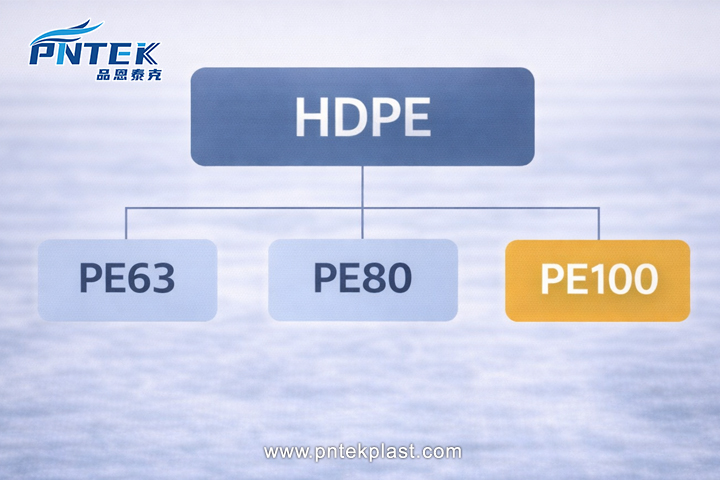
Think of “HDPE” as the name of a large, diverse family. Within this family, there are different generations, each with better capabilities than the last. The earliest pressure pipes were made from grades like PE63. Then technology improved, and we developed PE80. Today, PE100 is the modern, high-performance standard. The number in the name tells you its long-term strength. So, while a pipe might be made from a general-purpose HDPE resin, only a PE100-certified resin is guaranteed to meet that high-strength benchmark. When we manufacture pressure pipes at our facility, we only use virgin PE100 resin. This is a critical quality control point. It ensures every meter of pipe has the predictable, certified performance that infrastructure projects demand. It removes any guesswork about the material’s strength and longevity.
Comparing General HDPE to Certified PE100
| Feature | General HDPE | Certified PE100 |
|---|---|---|
| Category | A broad type of plastic material. | A specific grade of HDPE material. |
| Strength | Variable; may not be rated for high pressure. | Guaranteed Minimum Required Strength (MRS) of 10 MPa. |
| Application | Bottles, containers, non-pressure pipes. | High-pressure water and gas pipelines. |
| Certification | Not necessarily certified for pressure applications. | Conforms to international standards like ISO 4427. |
What is material grade PE100?
You hear about different material grades, but “PE100″ might just seem like a number. This can make you overlook its most important benefit. The grade is a direct promise of long-term strength.
Material grade PE100 is an international classification for HDPE resin that signifies a Minimum Required Strength (MRS) of 10 Megapascals (MPa). This grade guarantees the material’s ability to resist internal pressure over a 50-year service life without failing.
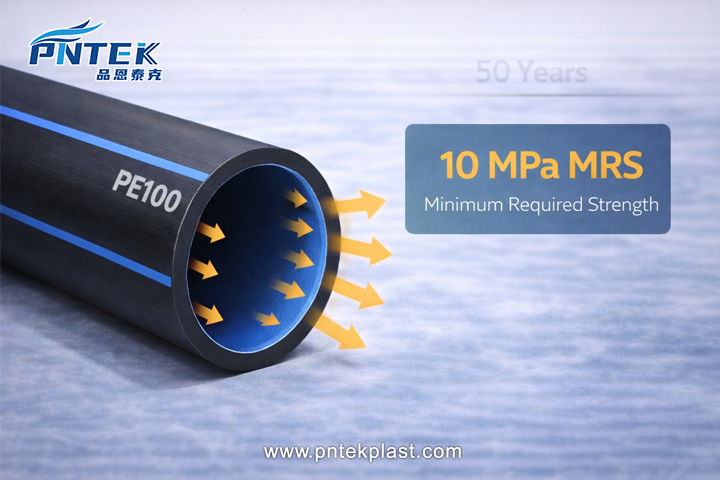
The “100″ is the most important part of the name. It comes from the 10.0 MPa rating. This engineering specification allows designers to calculate a pipe’s pressure capacity with a high degree of confidence. This has a very practical benefit that procurement managers with an engineering background immediately recognize: it affects the pipe’s wall thickness. Because PE100 is stronger than older grades like PE80, it can handle the same pressure with a thinner wall. We measure this with the Standard Dimension Ratio (SDR), which is the ratio of the pipe’s diameter to its wall thickness. For a given pressure class, a PE100 pipe will have a higher SDR (thinner wall) than a PE80 pipe. This means less raw material is used, which makes the pipe lighter, less expensive, and easier to handle and install. It also results in a larger internal bore, which improves flow capacity.
PE100 Advantage: Thinner Walls, Better Flow
| Pressure Class (PN) | Required SDR for PE80 | Required SDR for PE100 | Key Benefit of PE100 |
|---|---|---|---|
| PN10 (10 Bar) | SDR13.6 | SDR17 | 25% thinner wall, lighter, increased flow |
| PN16 (16 Bar) | SDR9 | SDR11 | 22% thinner wall, lighter, increased flow |
What density is PE100 material?
The term “High-Density” is in the name, but that can feel abstract. Without understanding what it means, you can’t appreciate why the material performs so well. The density is the source of its strength.
PE100 is a High-Density Polyethylene, and its material density typically falls in the range of 0.95 to 0.97 grams per cubic centimeter (g/cm³). This high density is what gives the material its rigidity, tensile strength, and excellent chemical resistance.
From a manufacturing perspective, density is everything. We create this high density at the molecular level. Polyethylene is made of long chains of molecules. In High-Density Polyethylene, these chains are very straight with very little branching. This allows them to pack together very tightly and form a crystalline structure. This tight packing is what “high density” means. It’s the reason the material is so strong and stiff. In contrast, Low-Density Polyethylene (LDPE) has chains with many branches. These branches prevent the chains from packing closely together, resulting in a lower density material that is soft and flexible, like a plastic bag. For a pipe that needs to hold pressure underground for decades, you need the strength that only comes from that tightly packed, high-density structure. This is a fundamental reason why PE100 is the superior choice for infrastructure.
Density and Its Effect on Properties
| Material | Density Range (g/cm³) | Molecular Structure | Resulting Properties |
|---|---|---|---|
| HDPE (PE100) | 0.95 – 0.97 | Tightly packed, low branching | Strong, rigid, durable |
| MDPE | 0.93 – 0.94 | Some branching | Good crack resistance |
| LDPE | 0.91 – 0.92 | Highly branched | Soft, very flexible, low strength |
What are the disadvantages of PE pipe?
No material is perfect for every situation. Ignoring the limitations of PE pipe can lead to costly design or installation errors. Understanding its weaknesses allows you to use it correctly and effectively.
The main disadvantages of PE pipe are its vulnerability to UV radiation without protection, a lower operating temperature limit than metal, and a high rate of thermal expansion. Proper installation also requires specialized fusion equipment and trained operators.
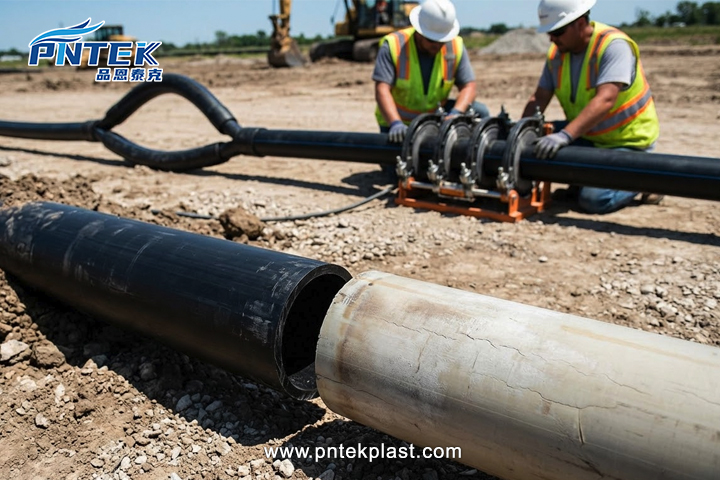
As a manufacturer, I believe in being honest about a product’s limitations. It builds trust and leads to better projects. First, PE pipe is susceptible to UV degradation from sunlight. We solve this by adding about 2–3% carbon black to the raw material. This is why pressure pipes are almost always black; the carbon black acts as a powerful UV stabilizer. Second, it has a lower temperature range than metal pipes. It should not be used for hot water applications above 60°C (140°F). Third, it expands and contracts with temperature changes more than steel or ductile iron. For above-ground installations, this must be managed with expansion loops or other design considerations. For buried pipes, this is less of an issue. Finally, joining HDPE requires trained technicians and fusion equipment. While this seems like a disadvantage, it is also its greatest strength, as it ensures a perfect, leak-proof joint every time.
Managing the Limitations of PE Pipe
| Disadvantage | The Solution or Mitigation |
|---|---|
| UV Degradation | Add carbon black during manufacturing for UV protection. |
| Low Temperature Limit | Use only for cold water or fluids below 60°C (140°F). |
| Thermal Expansion | Account for movement in design for above-ground lines; burial constrains it. |
| Requires Special Tools | Use certified technicians and proper fusion equipment to guarantee leak-proof joints. |
Conclusion
A PE100 pipe is the highest standard of HDPE, defined by its strength and durability. Understanding its properties and managing its few limitations allows you to build reliable, long-lasting infrastructure.
If you are looking for reliable HDPE PE100 pipes and fittings for your projects, feel free to contact us for product details and technical support.
Post time: Mar-12-2026


