
Joining plastic pipes can be nerve-wracking. A single bad connection can lead to catastrophic leaks down the line. A socket fusion coupling eliminates this risk by creating a seamless, welded joint.
A socket fusion coupling is a plastic fitting used to join two pipes. Using a special heating tool, the outside of the pipe and inside of the coupling’s socket are melted. They are then pushed together, creating a permanent, leak-proof weld as the plastic cools and solidifies.
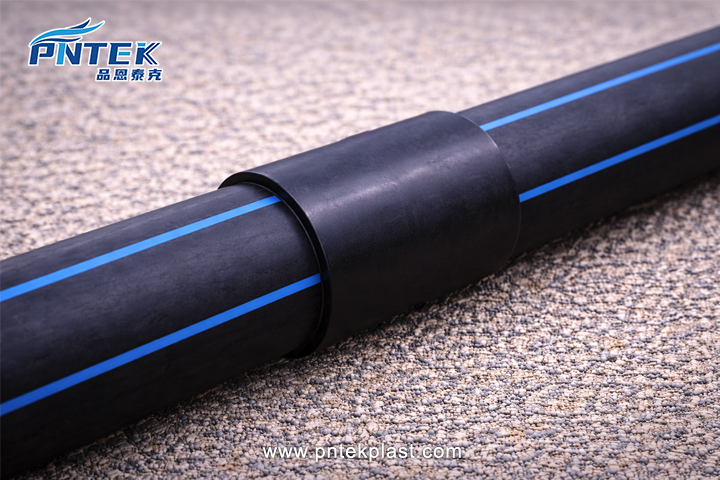
During a visit to a residential construction project in Jakarta, I observed the installation of the building’s water distribution system using our PE piping solution. On site, a technician prepared a socket fusion joint by heating the pipe and coupling to the specified temperature, then aligning and joining them with controlled pressure. Within moments, the connection formed a single, homogeneous structure — as strong as the pipe itself.
The site foreman later remarked, “This technology gives us confidence. Installation is efficient, and once the joint is completed, leaks are no longer a concern. Consistency like this is critical for maintaining project quality.”
Watching the process firsthand reinforced an important truth: when engineered materials are paired with the correct fusion method, the result is not just a connection, but a permanent part of the pipeline — delivering long-term reliability for modern water infrastructure.
What is a reducer socket used for?
You need to connect a large pipe to a smaller one. Using several fittings is inefficient and adds potential leak points. A reducer socket makes this transition in one simple, secure step.
A reducer socket, or reducing coupling, is a single fitting used to connect a larger diameter pipe to a smaller diameter pipe. It has two different sized sockets, allowing you to create a smooth, leak-proof transition in one simple fusion weld.
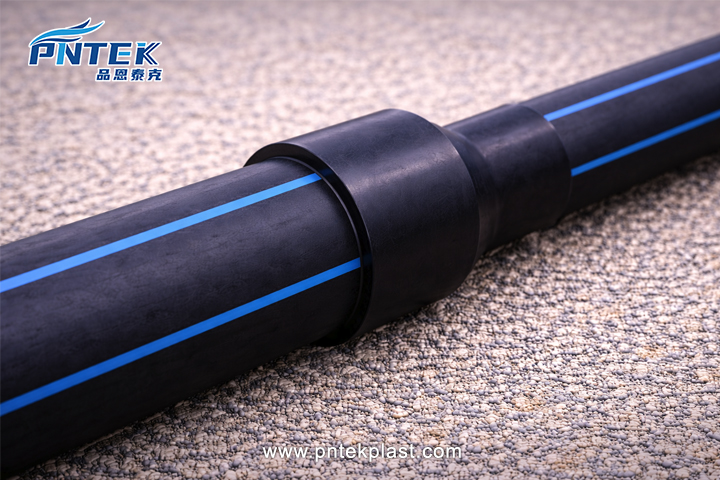
A reducer socket, which you’ll often see called a reducer coupling, has one core job: to connect a pipe of one size directly to a pipe of another, smaller size. This is a very common need in any plumbing or piping system. For example, you might have a main water line running at 63mm, but you need to branch off with a smaller 32mm line to supply a specific area or fixture. Instead of using multiple fittings to step down the size, the reducer coupling does it in a single, clean step.
The alternative would be to use a standard 63mm coupling and then insert a “reducer bushing” fitting inside it. This works, but it creates two joints instead of one. Every joint is a potential point of failure and takes time to create. The single-piece reducer coupling is superior because it minimizes joints, which means fewer welds, less labor time, and a more secure, reliable system overall. It also often provides a smoother transition for water flow, reducing turbulence and pressure loss compared to a more abrupt, multi-part connection.
Is a reducer coupling different from a reducer socket?
Piping catalogs have many different names for parts. Seeing “reducer coupling” and “reducer socket” can be confusing and lead to ordering mistakes. In reality, they are just two names for the same thing.
No, they are not different. “Reducer coupling” and “reducer socket” are interchangeable terms for the same HDPE fitting. Both refer to a single piece with two different sized sockets, designed to connect a larger pipe to a smaller pipe using socket fusion.
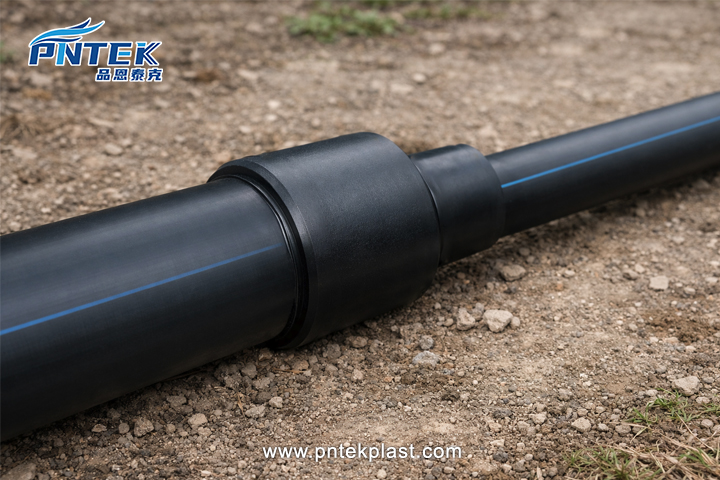
It’s very common in our industry to have multiple names for the same product, and this is a perfect example. Both terms, “reducer coupling” and “reducer socket,” accurately describe the part. The word “coupling” tells you its general job is to connect two pipes. The word “reducer” tells you it changes the pipe size. And the word “socket” describes the connection type. A socket is a smooth, hollow opening that the pipe end is inserted into. For HDPE, this connection is made permanent through a heat fusion weld. It is not a threaded connection.
Different regions or manufacturers might prefer one term over the other, but they are ordering the exact same item. For a purchasing manager like Budi, it’s most important to ignore the slight name difference and focus on the technical specifications. When you place an order, the name is less important than these three details:
- Material: HDPE PE100
- Sizes: What are the two pipe diameters it will connect? (e.g., 63mm x 32mm)
- Pressure Rating: What pressure does it need to handle? (e.g., PN16)
Focusing on these specifications ensures you always get the right part for the job, no matter what the supplier calls it in their catalog.
What does a reducer fitting look like?
On a busy job site, small fittings can get mixed up easily. Grabbing a straight coupling instead of a reducer can lead to mistakes that require cutting out a bad joint.
A reducer fitting, or reducer coupling, is a short, cylindrical piece of plastic. You can immediately identify it because one opening is visibly larger than the other. The sizes, like “63×32,” are always molded onto its side.
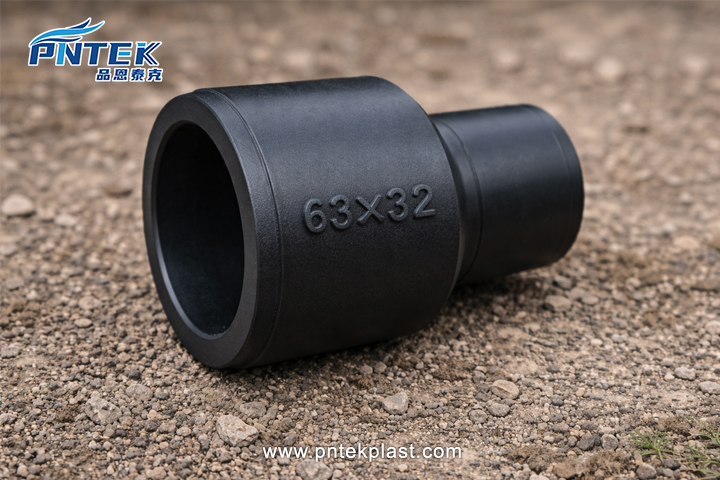
Visually identifying a reducer coupling is straightforward once you know what to look for. The most immediate clue is its asymmetrical shape. Unlike a standard, straight coupling which is a perfect cylinder, a reducer will look like a short, thick tube that tapers from a wide end to a narrower end. Even if the taper isn’t obvious on the outside, the openings themselves will be clearly different in diameter.
The best and most reliable way to identify it is to look at the markings molded directly onto the body of the fitting. As a quality manufacturer, we mold all the essential information onto our parts. You will see our brand name, the material type (like ‘PE 100′ or ‘PPR’), and the sizes. The size will be written as two numbers, for example, “63 x 32″. This tells you it connects a 63mm pipe to a 32mm pipe. The larger number always corresponds to the larger opening. If you look inside the sockets, you’ll also see a small ridge partway down. This is the stop that prevents you from pushing the pipe in too far during the heating and joining process, ensuring a perfect weld.
What is the difference between socket fusion and butt fusion?
You need to weld plastic pipes, but hear two different terms: socket fusion and butt fusion. Using the wrong method or machine for your job will result in failed welds and costly delays.
In socket fusion, a male pipe end is heated and inserted into a female fitting socket. It is used for smaller pipes (typically up to 110mm). In butt fusion, two plain pipe or fitting ends are heated and pressed directly together. This is for larger pipes.
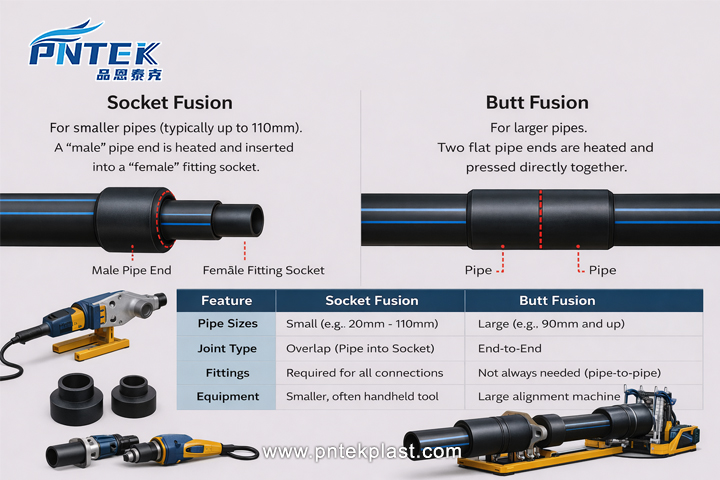
Although both methods use heat to create a permanent weld, the technique and application are completely different. The choice depends almost entirely on the diameter of the pipe.
Socket Fusion
This method involves a “male” and “female” component. You use a fitting, like a coupling or an elbow, that has a socket (the female part). The pipe end (the male part) is inserted into this socket. The heating tool has corresponding heads that heat the outside surface of the pipe and the inside surface of the socket at the same time. Once melted, you push them together. The overlap creates a very strong joint. This method is fast and efficient for smaller pipes, typically up to 110mm.
Butt Fusion
This method is for larger pipes where making a socket would be impractical. Here, the two ends being joined—whether pipe-to-pipe or pipe-to-fitting—are identical. A large machine holds the two ends in perfect alignment. A cutter “faces” the ends to make them perfectly flat and clean. Then, a large heating plate is placed between the two ends to melt them. The plate is removed, and the machine presses the two molten ends together to form a weld.
| Feature | Socket Fusion | Butt Fusion |
|---|---|---|
| Pipe Sizes | Small (e.g., 20mm – 110mm) | Large (e.g., 90mm and up) |
| Joint Type | Overlap (Pipe into Socket) | End-to-End |
| Fittings | Required for all connections | Not always needed (pipe-to-pipe) |
| Equipment | Smaller, often handheld tool | Large alignment machine |
Conclusion
The socket fusion coupling is a key component for creating strong, leak-proof joints. Understanding reducers and the difference between socket and butt fusion ensures you choose the right part.
Post time: Feb-06-2026


