Mechanical joints in your piping system always seem to be the first point of failure. A leaking gasket or a loose compression nut can cause major damage, costly repairs, and system downtime.
A socket fusion fitting is a thermoplastic fitting (like HDPE or PP-R) that is joined to a pipe by heat welding. A special tool melts the outside of the pipe and the inside of the fitting, which are then pushed together to form a single, permanent, leak-proof piece.
I remember talking with a client who was managing a large irrigation project. He was constantly dealing with leaks from traditional mechanical fittings caused by ground movement and water pressure changes. When I introduced him to the concept of socket fusion, it was a game-changer. The idea that the joint could be as strong as, or even stronger than, the pipe itself solved his biggest reliability problem. It’s a simple technology, but when you understand how it works, you see its massive advantages. Let’s dig into the details.
What exactly is a PE fitting made from?
You see “PE” on a fitting but don’t know what it means for strength. Choosing a fitting made from the wrong grade of plastic can lead to unexpected failures under pressure.
A PE fitting is made from polyethylene. For pressure piping, this is almost always High-Density Polyethylene (HDPE), a tough, flexible, and chemically resistant material perfect for demanding applications like water and gas distribution.
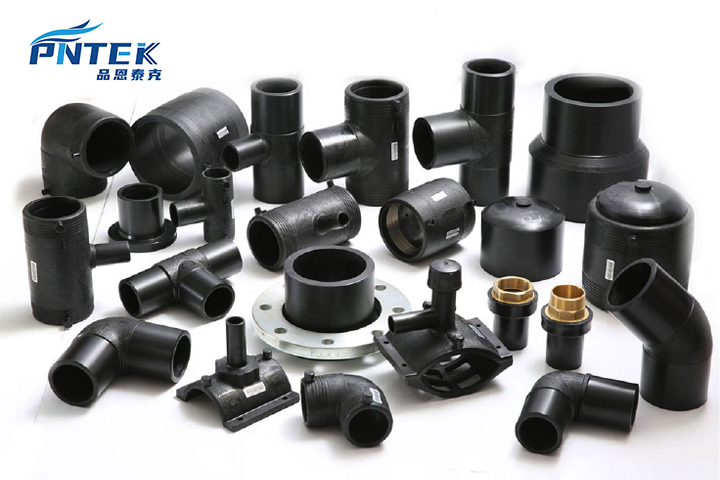
Polyethylene is a family of plastics, but not all types are created equal. The key is density. The higher the density, the stronger and more rigid the material. For socket fusion fittings used in water mains or industrial piping, we use HDPE, often specified as PE100. This grade has a very high molecular weight, giving it excellent resistance to pressure, impacts, and chemicals. It’s the same material used for the pipes themselves. This ensures that when you fuse a Pntek PE fitting to a PE pipe, you are joining two identical materials. This compatibility is the foundation for creating a perfect, monolithic weld that will last for decades without degrading. It’s a material engineered for long-term security.
Common Types of Polyethylene
| Type | Full Name | Key Properties | Common Uses |
|---|---|---|---|
| HDPE | High-Density Polyethylene | Strong, rigid, excellent chemical resistance | Pressure pipes, gas mains, chemical tanks |
| MDPE | Medium-Density Polyethylene | Good flexibility, crack resistant | Gas pipes, water service lines |
| LDPE | Low-Density Polyethylene | Very flexible, low strength | Plastic bags, tubing, food containers |
What kinds of pipes can you join with PE fusion?
You have a fusion tool, but you are not sure which types of plastic pipes it works with. Trying to fuse incompatible materials will result in a completely failed joint.
PE fusion is used to join similar thermoplastic materials. It is designed specifically for polyethylene (PE) pipes like HDPE and MDPE, as well as polypropylene (PP-R) pipes. You cannot fuse dissimilar plastics like PE to PVC.
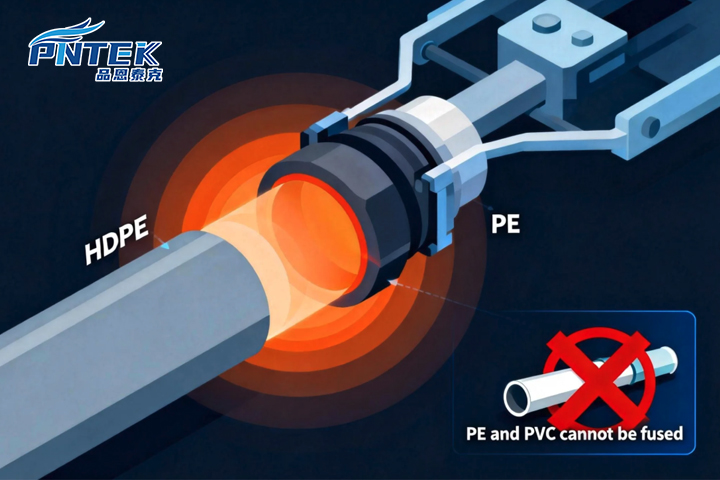
The principle of fusion welding is simple: you are melting and re-forming plastic. For this to work, the two parts you are joining must have the same chemical makeup and melting temperature. This is why you can only fuse “like with like.” The most common application is joining HDPE pipe to HDPE fittings for systems that demand absolute reliability. These include municipal water mains buried underground, high-pressure industrial chemical lines, and natural gas distribution networks. The same socket fusion process is also the standard method for joining PP-R pipes, which are very popular for hot and cold water plumbing inside buildings. The key takeaway is that fusion creates a seamless system, but only when the pipe and fitting materials are a perfect match.
How do you actually fuse HDPE pipes and fittings together?
The process of fusion welding can seem complicated. One wrong move, and you could create a weak joint that fails later, destroying confidence in your installation work.
To fuse HDPE, you heat the pipe’s outer surface and the fitting’s inner surface with a tool for a set time. Then, you press them together and hold until cool. This creates a permanent, welded joint.
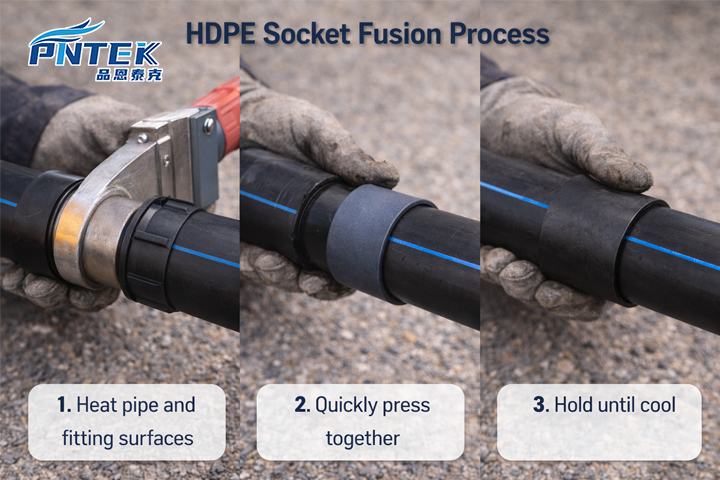
The process is precise but straightforward if you follow the steps.
- Preparation: First, cut the pipe end perfectly square. Then, clean the pipe end and the inside of the fitting socket to remove any dirt or grease.
- Heating: The socket fusion tool has heating adapters for different pipe sizes. Push the pipe into one side and the fitting onto the other side at the same time. The heating time is critical and depends on the pipe diameter.
- Joining: Once the heating time is up, quickly and smoothly remove both parts from the tool. Immediately push the pipe straight into the fitting’s socket until it stops. Do not twist.
- Cooling: Hold the joint perfectly still for the specified cooling time. This allows the melted plastic to solidify into a single, strong piece.
Following the correct heating and cooling times is essential for a reliable weld.
Why is a fusion fitting stronger than a mechanical joint?
You use mechanical fittings because they are easy to install. But you know that every gasket and every thread is a potential point of failure that can loosen over time.
A fusion fitting is stronger because it eliminates the joint entirely. The pipe and fitting become one solid piece of plastic. This monolithic connection has no gaskets to degrade or bolts to loosen, making it stronger than the pipe itself.
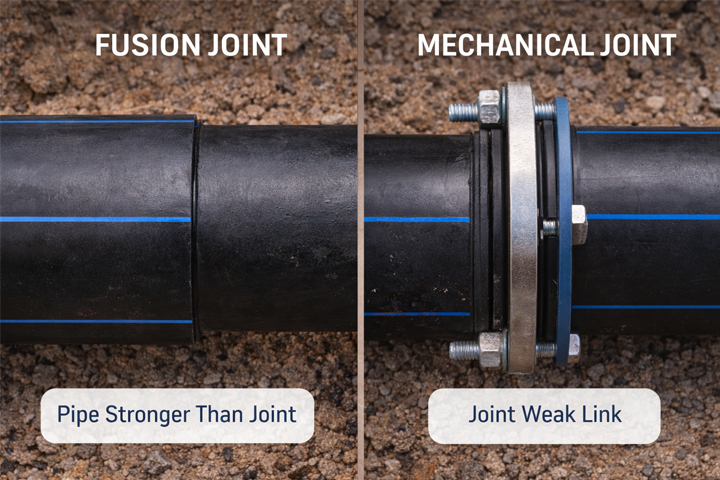
A mechanical joint connects two parts, but a fusion weld unifies them. Think about a metal chain; it is only as strong as its weakest link. In a pipeline with mechanical fittings, the joints are the weak links. They rely on the compression of a rubber gasket or the friction of threads to create a seal. These can be affected by vibration, temperature changes, and ground movement. A fusion weld has none of these weaknesses. The process of melting and re-forming the HDPE means the area of the joint becomes a solid block of plastic with no seam. When we do burst pressure tests in our lab, the pipe wall will always fail before the fused joint does. This is why for critical, zero-leak tolerance applications buried underground or set in concrete, fusion is the only truly reliable choice.
Fusion vs. Mechanical Joints
| Feature | Fusion Joint | Mechanical Joint |
|---|---|---|
| Leak Points | Zero | Multiple (gaskets, threads) |
| Joint Strength | Stronger than the pipe | Weaker than the pipe |
| Long-Term Reliability | Excellent | Fair to Good |
| Corrosion | Not possible | Can occur on metal parts |
Conclusion
Socket fusion creates a superior joint by welding the pipe and fitting into one solid piece. This eliminates leak points, making it the most reliable method for PE and PP-R systems.
Post time: Jan-29-2026