
Are you worried about choosing the wrong connection type for your valves? A mismatched thread or a poor connection can cause persistent leaks, project delays, and damage your professional reputation.
A threaded ball valve is a valve that uses screw threads on its ends to connect to a pipe or fitting. This design allows for simple installation and removal with basic tools, without needing special welding or gluing equipment. They come in various thread standards.
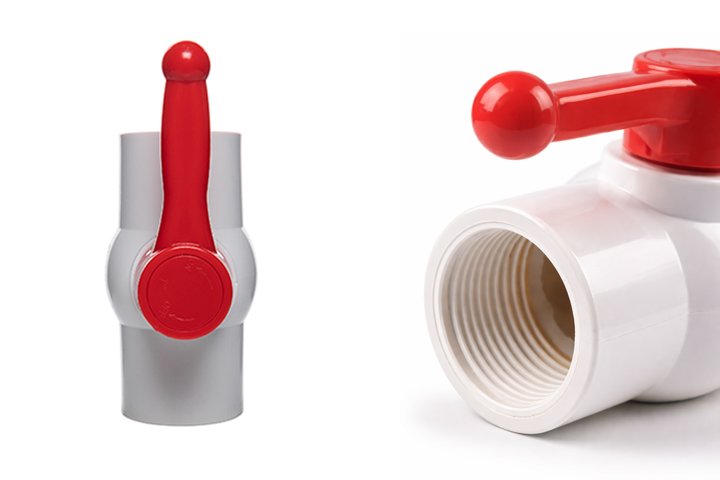
This simple screw-in connection is one of the most common in the world, but the details are what matter. As someone who has built a company on providing world-class water management solutions, I know that even the simplest component must be right. For a purchasing manager like Carlos, supplying the correct threaded valve means his customers can complete their work quickly and reliably. It’s a fundamental part of building a successful project and a lasting partnership.
Is NPT the same as threaded?
Are you assuming all threads are the same? Ordering a “threaded” valve without specifying the standard can lead to receiving parts that won’t connect, causing costly returns and frustrating delays for your clients.
No, NPT is not the same as threaded; it is a specific type of thread. “Threaded” is the general term for a screw-in connection, while NPT (National Pipe Thread) is a U.S. standard for tapered threads. Other standards, like BSPT, also exist.
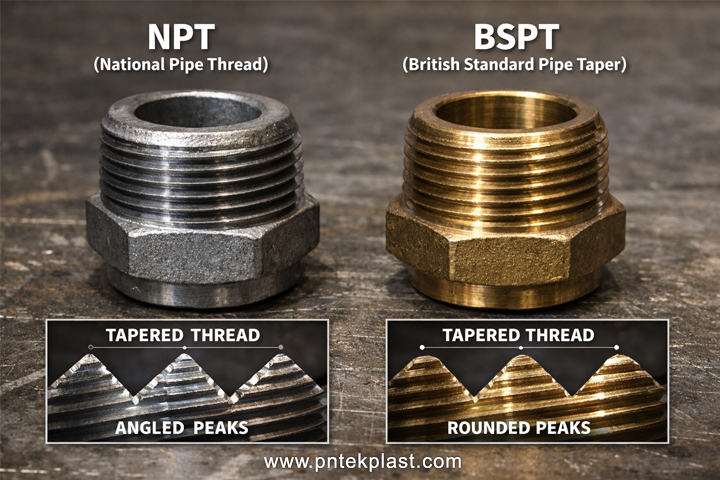
I work with partners in over 50 countries, so managing standards is a huge part of my job. This distinction is critical for international trade. If Carlos in Mexico orders a valve for a project using American pipe, he needs NPT. If he were sourcing for a project with British equipment, he might need BSPT. They look similar, but they are not compatible. Using the wrong one will result in a joint that either won’t seal or will damage the threads.
Understanding the Most Common Thread Standards
Knowing the difference is key to preventing connection failures. For most applications in the Americas, NPT is the standard, but it’s important to be aware of the alternative.
| Feature | NPT (National Pipe Thread) | BSPT (British Standard Pipe Taper) |
|---|---|---|
| Region | Primarily North America (USA, Canada, Mexico) | UK, Europe, Asia, Australia |
| Thread Angle | 60 degrees | 55 degrees |
| Profile | Flattened peaks and valleys | Rounded peaks and valleys |
| Compatibility | Not compatible with BSPT. | Not compatible with NPT. |
For Carlos, stocking and clearly labeling valves by their thread standard (NPT or BSPT) prevents confusion for his customers and ensures they get the right part the first time.
What is an NPT ball valve?
Does your project specification call for an NPT valve? If you are unsure what this means for installation, you might miss a critical step and end up with a leaky connection.
An NPT ball valve is simply a ball valve manufactured with NPT (National Pipe Thread) standard threads. The tapered design of these threads creates a tight seal by wedging together as the valve is tightened onto a pipe or fitting.
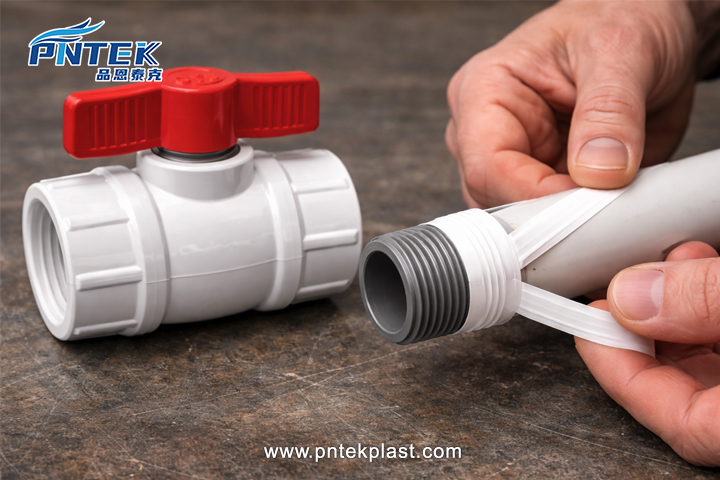
The tapered thread is the key feature here. Unlike a straight thread on a bolt, an NPT thread gets wider as it goes. This design is meant to create an interference fit, pressing the threads together to form a seal. However, this mechanical seal is not perfect. I always insist that our partners understand this: an NPT connection always requires a thread sealant. This could be PTFE tape (Teflon tape) or a liquid pipe dope. The sealant fills the tiny gaps between the threads that the mechanical force can’t close. Skipping this step is one of the most common causes of leaks in threaded systems. It’s a simple step that guarantees a professional, leak-proof result. These valves also come in different configurations, such as with two female threaded ends (the most common), or with one male and one female end for specific connection needs.
Can you add threads to PVC pipe?
Do you need to connect a threaded valve to a plain-end PVC pipe? Trying to cut threads directly into the pipe is a huge mistake that will weaken it and cause it to fail.
Yes, you can add threads, but you must use a special adapter fitting. You should never cut threads directly into a PVC pipe wall. Instead, you use solvent cement to glue a PVC adapter with pre-molded threads onto the end of the plain pipe.
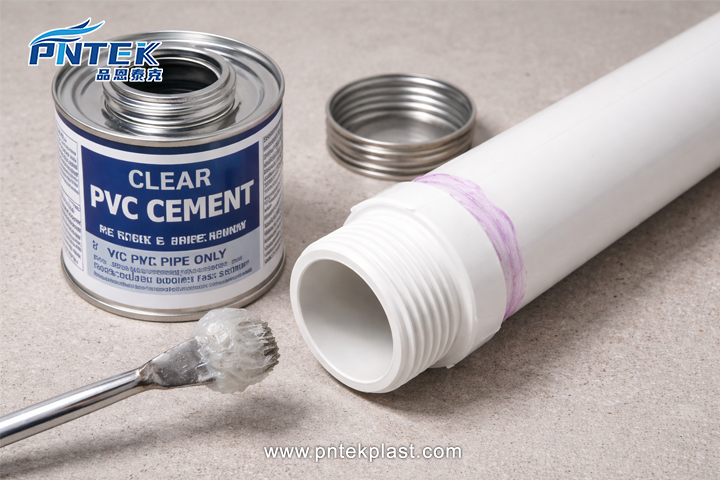
At Pntek, quality and safety are our highest priorities. Cutting threads into the wall of a PVC pipe, especially Schedule 40, removes material and creates stress points. It drastically reduces the pipe’s pressure rating and makes it very likely to crack or burst when pressurized. The correct and professional method is to use an adapter.
The Correct Way to Add Threads to PVC
- Choose the Right Adapter: Select a PVC adapter fitting. If you need male threads, use a “male adapter.” If you need female threads, use a “female adapter.” One end will have the threads, and the other will be a smooth socket.
- Prepare the Pipe and Fitting: Clean the end of the PVC pipe and the inside of the adapter’s socket. Apply PVC primer to both surfaces.
- Apply Solvent Cement: Apply an even layer of PVC solvent cement over the primer on both the pipe and the fitting.
- Join and Hold: Immediately push the pipe into the adapter’s socket with a slight twisting motion. Hold it firmly for about 30 seconds to allow the cement to set.
This creates a strong, permanent, factory-quality threaded connection point without compromising the integrity of the pipe.
How to connect PVC without threads?
Are you looking for an alternative to threaded connections for your PVC system? Sometimes, a permanent, welded joint is a more secure and reliable option for specific applications.
To connect PVC without threads, you use solvent cement and socket (or “slip”) fittings. A socket ball valve has smooth ends that the PVC pipe slips into. You apply primer and cement to create a permanent, chemically welded bond that is incredibly strong.
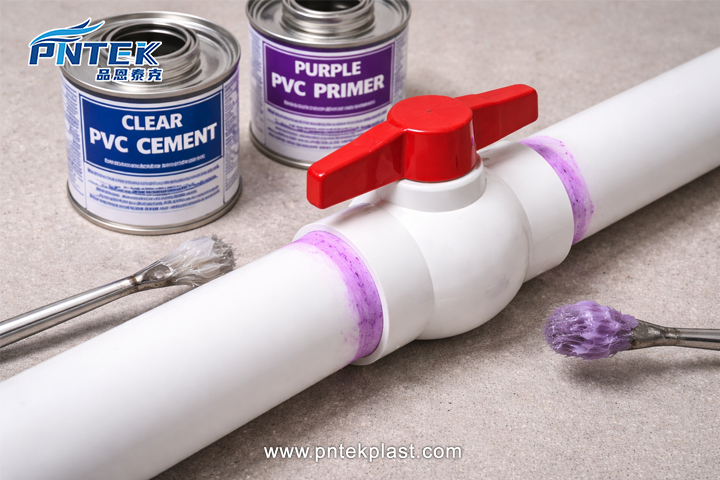
While threaded connections are great for serviceability, solvent-welded joints are often stronger and have fewer potential leak paths. At Pntek, we offer a full range of solutions because we know every job is different. For permanent installations where the valve won’t need to be removed, a socket valve is an excellent choice.
Comparing PVC Connection Types
For a purchasing manager like Carlos, having different options means he can better serve his customers’ needs. Here is a quick breakdown of the most common methods for installing a ball valve in a PVC line:
| Connection Type | How It Works | Best For | Key Advantage |
|---|---|---|---|
| Threaded | Male and female threads are screwed together. | Serviceable connections; connecting to metal. | Can be disassembled for repair or replacement. |
| Socket (Slip) | Pipe is glued directly into the valve’s sockets. | Permanent installations; maximum flow. | Creates a strong, permanent, leak-proof bond. |
| True Union | Valve body is removable; end connectors are glued on. | Areas needing maintenance; pump and filter hookups. | Combines a permanent weld with easy valve removal. |
| Flanged | End flanges are bolted together. | Large diameter pipes (>4″); industrial applications. | Very strong and serviceable for heavy-duty use. |
The True Union ball valve is often the best of both worlds, offering the security of a solvent weld with the serviceability of a threaded or flanged valve.
Conclusion
A threaded ball valve uses screw threads, like the NPT standard, for easy installation. To connect to PVC, always use a glued-on adapter, or choose a socket or union valve instead.
Post time: Mar-30-2026


