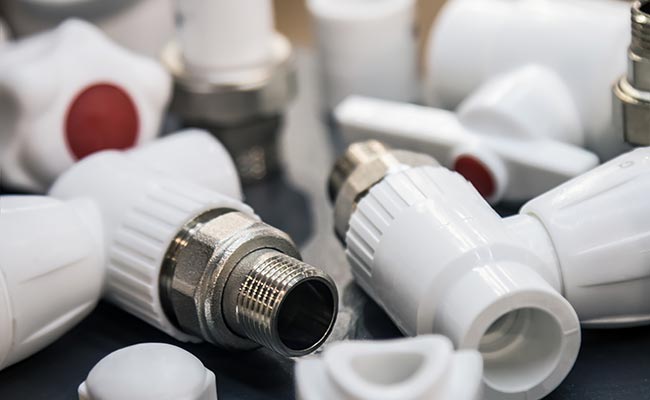
During construction, you see open pipe ends everywhere. These unprotected openings are a huge risk for contamination from dirt, rainwater, or debris, which can compromise the entire system later on.
An end cap is a fitting used to seal the end of a pipe. Its main purpose is to stop the flow and create a permanent, leak-proof termination point, but it’s also critical for pressure testing and keeping the pipe system clean during installation.
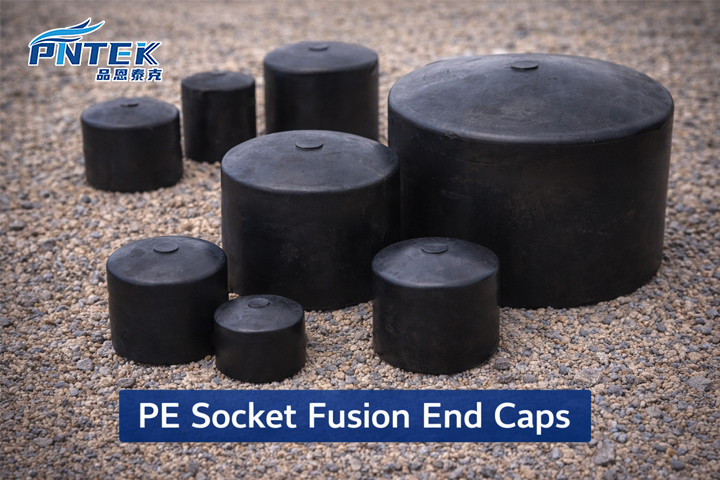
I was visiting a large-scale housing project with a client once. The plumbing contractor had laid hundreds of meters of water lines but hadn’t started connecting the fixtures yet. To protect their work, they had fused an end cap onto every single open pipe end. The site manager told me, “It’s the cheapest insurance I can buy.” He was right. It prevented dirt and debris from getting into the lines during the rest of the construction, and it allowed them to pressure test the entire network section by section. This simple fitting saved them from huge potential problems down the road. It shows that even the smallest parts can have a huge impact.
What is an end cap in piping?
You see a dead end in a piping diagram marked with a symbol. Is this just a temporary plug, or is it a permanent, structural part of the system?
An end cap is a type of fitting designed to provide a definitive, sealed termination to a pipe or a fitting outlet. Unlike a temporary plug, a properly installed end cap is designed to hold the full pressure of the system.
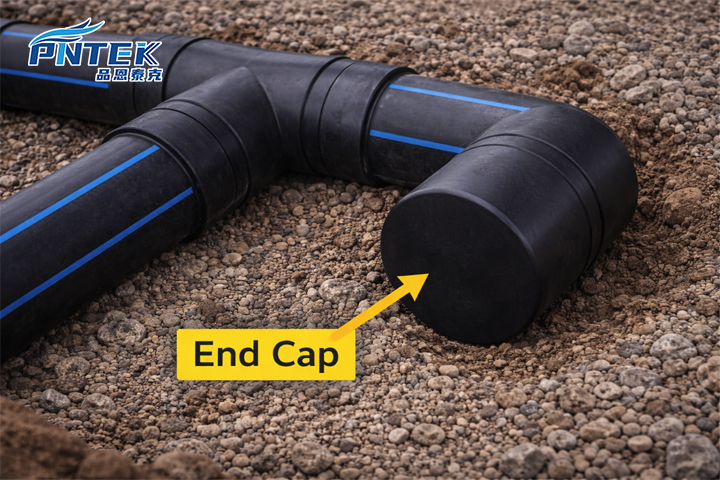
In the world of piping, there are many ways to stop a pipe, but the end cap is the most permanent and reliable solution. It’s not just a temporary stopper; it’s an engineered component. Think of it as a wall, not a door. Its function is to completely close off a branch or the end of a main line. In any piping system, fittings are used to connect, control, or change the direction of flow. The end cap’s unique role is to stop it. This is crucial for creating a closed-loop system for testing or for permanently ending a line where it is no longer needed. While a simple friction plug might keep out dirt during storage, only a true end cap, whether threaded, solvent-welded, or fusion-welded, is trusted to handle pressure and provide a long-term seal.
What makes a PE end cap special?
You need to cap a modern HDPE pipe. You know a traditional PVC or metal cap won’t work. What is the correct component for this job?
A PE end cap is an end cap made from High-Density Polyethylene (HDPE). It is not glued or threaded but is welded directly onto the PE pipe using socket fusion or butt fusion, creating a monolithic, leak-proof seal.
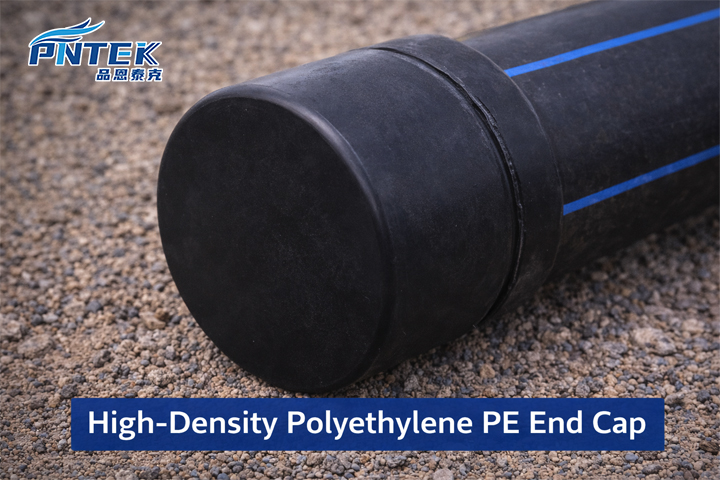
The special thing about a PE end cap is that it’s made from the exact same material as the pipe it’s designed to seal: high-density polyethylene. This is critical because of how it is joined. You don’t use glue, gaskets, or threads. Instead, you use a heat fusion process. This process melts the surface of the pipe and the inside of the end cap’s socket. You then push them together, and as they cool, the plastic molecules from both parts intermingle and solidify. The result is not a connection; it’s a transformation. The pipe and cap become a single, solid piece of PE. This means the end cap has the same strength, chemical resistance, and pressure rating as the pipe itself. There is no weak point. For a partner like Budi in Indonesia, this is key for long-term buried infrastructure.
What is the real purpose of an end cap?
An end cap seems like a very simple part. But using it only for stopping a leak means you are missing its most valuable strategic uses in system design and installation.
Its primary purpose is termination, but it’s also essential for pressure testing a new system, preventing contamination during construction, and providing a point for future expansion of the pipeline.
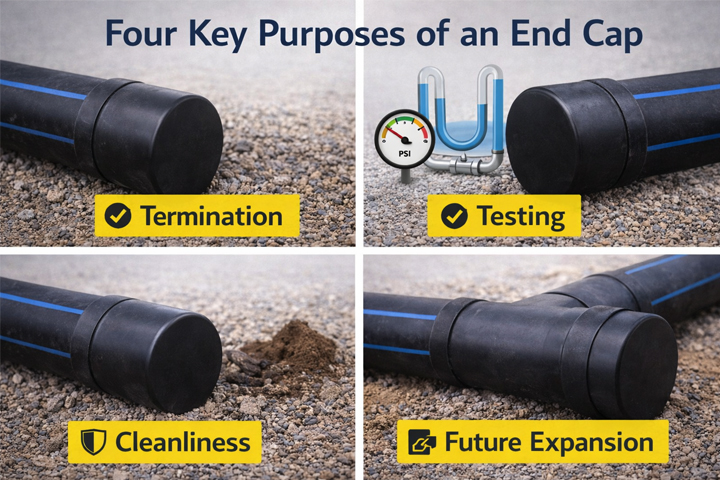
The end cap is more versatile than it looks. Understanding its different roles is key to efficient project management.
- Termination: This is the most obvious use. When a water line ends, you cap it. The end cap provides a permanent, secure seal that can withstand the system’s full operating pressure for decades.
- Pressure Testing: This is one of its most critical functions. Before a new pipeline is buried or put into service, it must be tested for leaks. Installers will cap all the open ends of a completed section, fill it with water or air, and pressurize it to see if it holds. A reliable end cap is essential for a successful test.
- Future Expansion: This is smart planning. Imagine you are installing a main water line. You know that in two years, a new building will be constructed. You can install a tee fitting in the main line and seal the unused branch with an end cap. When it’s time for expansion, you can simply cut off the cap and connect the new line without interrupting the main service.
- Cleanliness and Safety: During construction, open pipes are a magnet for dirt, debris, and even small animals. Capping pipes as you go keeps the interior of your system clean and safe.
How do you install and use an end cap?
You have your PE pipe and your PE end cap. An improper weld will fail under pressure, so how do you ensure the connection is perfect?
To use a socket fusion PE end cap, you heat the outside of the pipe and the inside of the cap’s socket simultaneously with a fusion tool. Then, you push the pipe firmly into the cap and hold it until it cools.

The process is identical to joining a coupling, but you are creating a termination point instead of a continuation. It is simple but requires precision.
- Cut & Clean: Make sure the end of your PE pipe is cut perfectly square. Clean the last few inches of the pipe’s outer surface and the inside of the end cap’s socket with a clean, dry cloth. Any dirt can cause a bad weld.
- Heat: With your socket fusion machine heated to the correct temperature for PE, simultaneously insert the pipe end and the end cap socket onto the heating tool. The heating time depends on the pipe’s diameter.
- Join: Once the heating time is complete, quickly and smoothly remove both the pipe and the cap from the tool. Immediately push the pipe straight into the end cap’s socket until it reaches the end. Do not twist it.
- Cool: Hold the joint steady without any pressure for the recommended cooling time. This allows the melted PE to solidify into a single, strong piece. Once cooled, the joint is complete and ready to handle pressure.
Conclusion
The humble end cap is a critical fitting. It provides permanent termination, enables pressure testing, and allows for future expansion, ensuring system integrity from construction to long-term operation.
Post time: Feb-02-2026