
Choosing the right pipe material is confusing with all the jargon. You worry that picking the wrong grade could compromise your entire project. PE100 is simply a high-performance classification of HDPE.
PE100 is a specific, high-performance grade of HDPE (High-Density Polyethylene). While all PE100 is HDPE, not all HDPE meets the PE100 standard. PE100 offers a higher strength and crack resistance, allowing for thinner walls and higher pressure ratings compared to older HDPE grades.
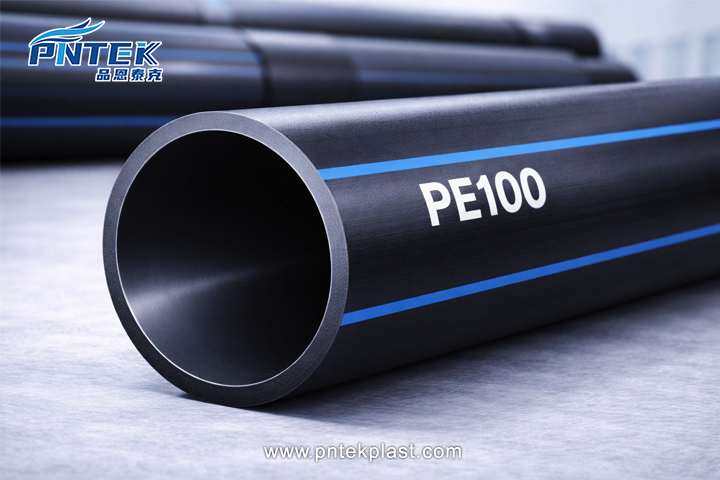
In my nearly two decades of manufacturing plastic piping, this is one of the most common questions I get. It’s a simple question with an important answer. Think of it like this: “HDPE” is the family name, and “PE100″ is a specific, highly capable member of that family. As a manufacturer, we almost exclusively use PE100 resin for our pressure pipes because it provides the best long-term performance and safety. For procurement managers like Arief in Indonesia, who oversee critical infrastructure, knowing you’re getting PE100 grade means you are getting the modern standard for strength and reliability. Let’s break down exactly what these terms mean for your projects.
Is PE100 the same as HDPE?
You see both terms used, sometimes together, and it’s unclear if they are interchangeable. This confusion can make it hard to compare products. PE100 is a premium version of HDPE.
No, they are not exactly the same, but they are directly related. PE100 is a specific classification of HDPE. It is a modern, third-generation grade of HDPE that is certified to have a higher minimum required strength (MRS) and better stress crack resistance than older grades.
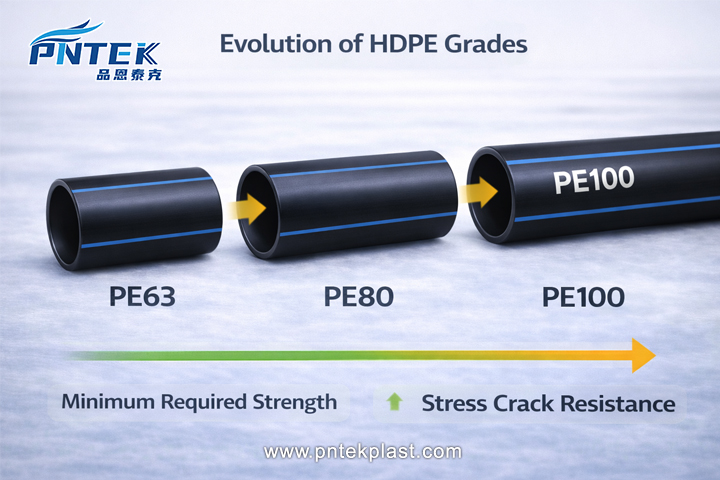
The key is understanding that HDPE has evolved over the decades. In the beginning, we had grades like PE63. Then came the improved PE80. Now, PE100 is the industry standard for most pressure applications. The number refers to the pipe’s long-term strength. Specifically, it represents the Minimum Required Strength (MRS) in megapascals (MPa) after 50 years of service life. So, a PE100 pipe can withstand a continuous internal pressure of 10.0 MPa for 50 years at 20°C. This higher strength means we can design pipes with thinner walls for the same pressure rating, which saves material and cost. At our factory, specifying PE100 virgin resin is a non-negotiable first step. It ensures every pipe we produce starts with the best foundation for long-term performance.
The Evolution of HDPE Pressure Pipe Grades
| Grade | Minimum Required Strength (MRS) | Introduced | Key Characteristic |
|---|---|---|---|
| PE63 | 6.3 MPa | 1960s | First generation pressure pipe material. |
| PE80 | 8.0 MPa | 1980s | Improved strength and crack resistance. |
| PE100 | 10.0 MPa | 1990s | High strength, excellent stress crack resistance. The modern standard. |
Which is better, PE or HDPE?
You are faced with different plastic options and need to know which is best for your pipeline. The terminology itself can be confusing. HDPE is simply the best type of PE for pipes.
This question can be misleading because HDPE is a type of PE (Polyethylene). For pressure pipes, HDPE is always the better choice over other PE types like LDPE or MDPE. Its high density provides the necessary strength, rigidity, and durability for infrastructure.
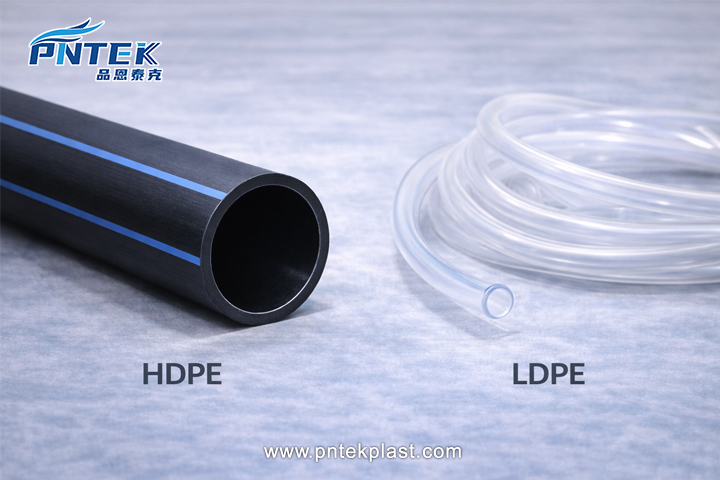
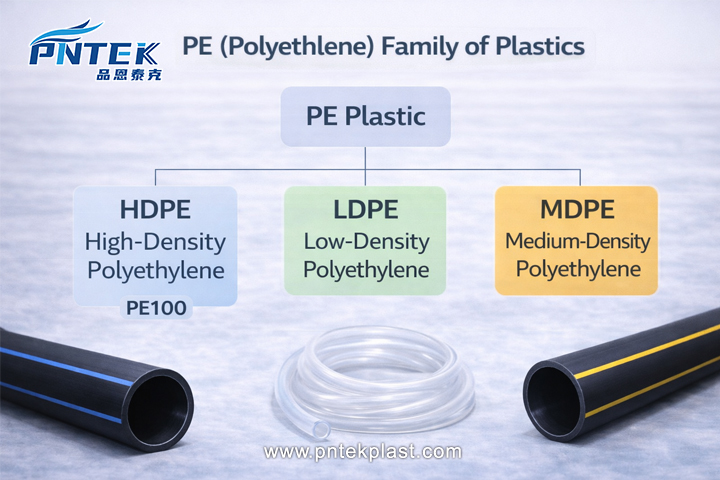
The “PE” in HDPE stands for Polyethylene, which is a huge family of plastics. This family includes many different types based on their density. The main ones you will encounter are Low-Density (LDPE), Medium-Density (MDPE), and High-Density (HDPE). The density directly impacts the material’s properties. LDPE is very soft and flexible, which is great for things like plastic bags or squeeze bottles, but terrible for a pipe that needs to hold pressure. MDPE is a middle ground, often used for gas pipes in the past. HDPE, however, has a tightly packed molecular structure. This gives it the high strength, chemical resistance, and rigidity needed to handle the pressure and external loads of buried pipelines. So, when talking about pipes, the real question isn’t PE vs. HDPE; it’s which type of PE is right for the job. For any pressure application, the answer is always HDPE.
Comparing Types of Polyethylene (PE)
| Type | Full Name | Density | Key Properties | Common Application |
|---|---|---|---|---|
| HDPE | High-Density Polyethylene | High | Strong, rigid, durable, chemical resistant | Pressure pipes, water tanks, bottles |
| MDPE | Medium-Density Polyethylene | Medium | Good shock & drop resistance | Gas pipes, shrink film |
| LDPE | Low-Density Polyethylene | Low | Very flexible, soft | Plastic bags, food wraps, squeeze bottles |
Is PE plastic the same as HDPE?
You see “PE plastic” on a specification sheet and wonder if it’s good enough. This ambiguity is a red flag. Insist on “HDPE” to ensure you get the right material.
No, PE (Polyethylene) plastic is a broad family of materials, while HDPE (High-Density Polyethylene) is a specific type within that family. Saying something is “PE plastic” is too general for a technical application like piping, as it could also mean weaker LDPE or MDPE.
Think of it as the difference between saying you drive a “car” versus saying you drive a “truck.” Both are vehicles, but they are designed for very different purposes. The term “PE plastic” is like “car”—it’s a general category. HDPE, LDPE, and MDPE are like “truck,” “sports car,” and “sedan.” They are specific types with different performance characteristics. I’ve seen suppliers try to sell products specified only as “PE.” This is a tactic I caution buyers against. For any project that requires strength and longevity, like a municipal water line or mining slurry pipe, you must ensure the specification clearly states HDPE, and preferably PE100. As a manufacturer committed to quality, we are very clear about the materials we use. Specificity is everything because it guarantees the engineering properties you rely on for a safe and durable system.
Why Specificity Matters
| General Term | What It Could Mean | Specific Term | What It Guarantees |
|---|---|---|---|
| PE Plastic | LDPE, MDPE, or HDPE | HDPE | High strength and rigidity for pressure. |
| PE Pipe | Could be a low-pressure irrigation tube. | HDPE PE100 Pipe | Certified for 10 MPa MRS, suitable for critical infrastructure. |
| Plastic Fitting | Could be PVC, PP, or another material. | HDPE Socket Fusion Fitting | Designed to fuse with HDPE pipe for a monolithic joint. |
What is PE100 material?
You need the strongest, most reliable pipe available. Seeing “PE100″ on a product should give you confidence, but only if you know what it means. It is a promise of performance.
PE100 is a high-performance grade of HDPE that has a Minimum Required Strength (MRS) of 10 MPa. This international classification guarantees the material’s ability to withstand high pressure over a long service life, making it the premier choice for modern water and gas pipelines.
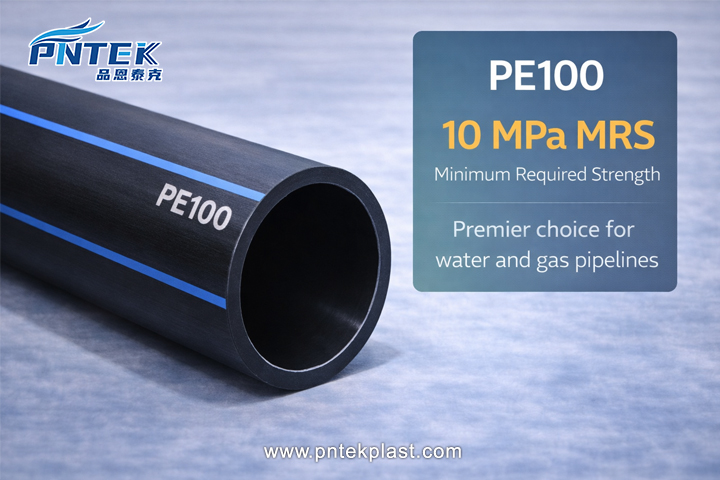
The “100″ in PE100 is the most important part. It means the material is certified to handle 10 Megapascals of stress for 50 years. This high strength has a huge practical benefit that managers like Arief, with his engineering background, appreciate. It allows us to design pipes with a higher Standard Dimension Ratio (SDR), which is the ratio of the pipe’s diameter to its wall thickness. A higher SDR means a thinner wall for the same pressure rating. This not only reduces the material cost and weight of the pipe, making it cheaper and easier to install, but it also results in a larger internal diameter. A larger bore increases the flow capacity of the pipeline, which can be a major advantage in system design. PE100 is not just a stronger material; it’s a smarter and more efficient one.
The PE100 Advantage: SDR and Pressure
| Pressure Class | Required SDR for PE80 | Required SDR for PE100 | Advantage of PE100 |
|---|---|---|---|
| PN10 (10 Bar) | SDR13.6 | SDR17 | Thinner wall, lighter, more flow |
| PN12.5 (12.5 Bar) | SDR11 | SDR13.6 | Thinner wall, lighter, more flow |
| PN16 (16 Bar) | SDR9 | SDR11 | Thinner wall, lighter, more flow |
Conclusion
PE100 is not different from HDPE; it is the best class of HDPE. Specifying PE100 ensures you get the highest strength and most reliable performance for your critical pipeline projects.
If you are looking for reliable HDPE PE100 pipes and fittings for your projects, feel free to contact us for product details and technical support.
Post time: Mar-11-2026


