
You see PE80 and PE100 on technical specifications. The numbers are different, but it’s not clear what this means for your project. This confusion could lead to choosing a weaker or more expensive option.
The main difference is strength. PE100 has a 25% higher Minimum Required Strength (MRS) than PE80. This allows PE100 pipes to have thinner walls for the same pressure rating, making them lighter, more cost-effective, and providing better flow capacity.
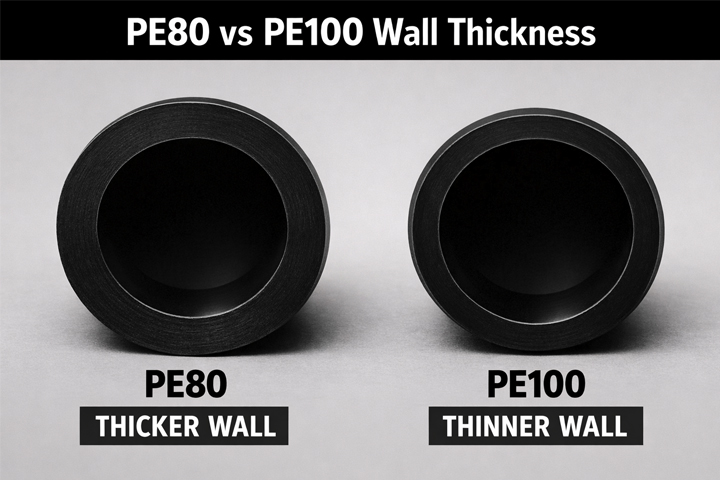
This isn’t just a small technical detail; it’s a fundamental improvement in material science that has huge practical benefits. As a manufacturer, I can tell you that the shift from PE80 to PE100 as the industry standard was a major step forward. A savvy procurement manager like Arief in Indonesia understands this immediately. He sees that PE100 allows him to deliver the same performance with a more efficient, lighter, and easier-to-install product. The difference between these two grades affects everything from the project budget to the long-term reliability of the entire system.
What size is PE100 pipe?
You need pipe for your project, but you wonder if PE100 comes in the size you need. This uncertainty can make it difficult to specify materials and plan your project pipeline effectively.
PE100 pipe is available in a vast range of standard sizes, from small 20mm diameters up to very large 2500mm diameters. PE100 is the material grade, not a size, so it can be manufactured to almost any required dimension for any application.
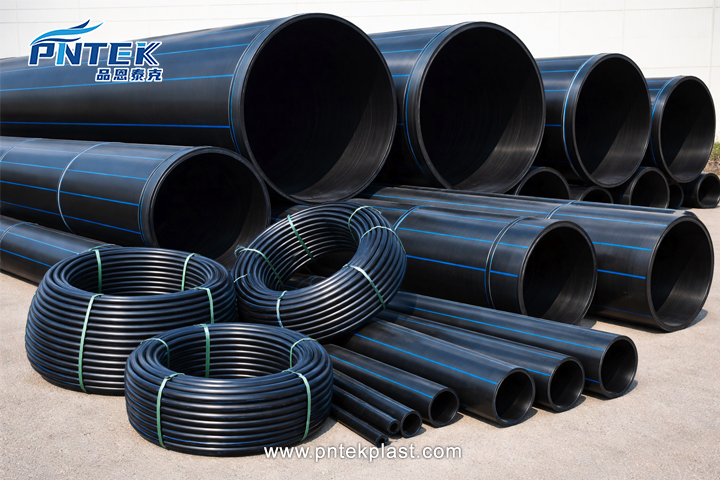
A common point of confusion is thinking that “PE100″ refers to a size. It’s important to remember that PE100 is the material grade. At my factory, we use this single high-performance grade to produce a huge variety of pipe sizes. We simply change the extrusion dies to create pipes from 20mm up to 800mm or more. Smaller diameters, typically up to 110mm, can be supplied in long coils, which dramatically reduces the number of joints needed for installation. Larger diameters are produced in straight lengths, usually 6 or 12 meters long. The size you need is almost certainly available, because the material itself is so versatile. It can be adapted for anything from a small residential water line to a massive municipal water transmission main.
Common PE100 Pipe Sizes and Applications
| Diameter Range | Typical Form | Common Applications |
|---|---|---|
| 20mm – 110mm | Coils or straight lengths | Residential connections, irrigation, telecoms ducting |
| 125mm – 630mm | Straight lengths (6m or 12m) | Municipal water distribution, industrial process lines |
| 710mm – 2500mm | Straight lengths | Large-scale water transmission, sewer outfalls, mining |
What’s stronger, PE or PVC?
You need to choose between PE and PVC, and both are called “strong”. It is difficult to know which material is truly tougher and better suited for the demands of your installation.
It depends on how you define strength. PVC is more rigid and has a higher tensile strength. However, HDPE (PE) is much more flexible and has far superior impact strength, especially in cold weather. HDPE can bend and take hits that would shatter PVC.
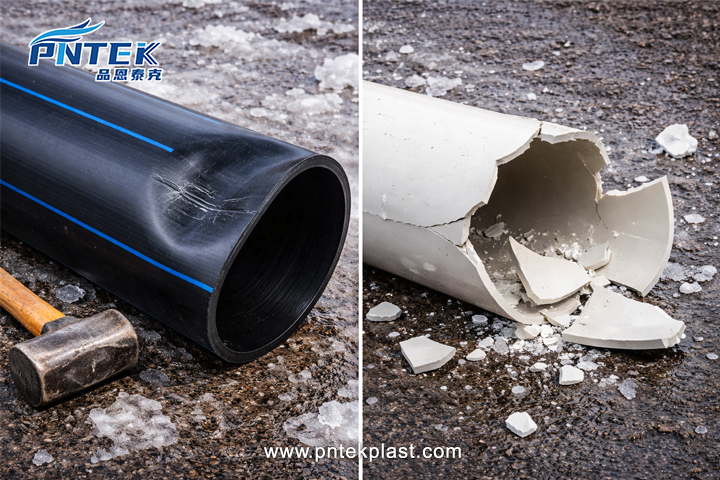
When engineers talk about “strength,” they mean several different properties. PVC is very stiff. This means it resists bending, which can be useful in some above-ground applications where you don’t want the pipe to sag. However, this same rigidity makes PVC brittle. A sharp impact from a rock during backfilling, or even being dropped during a cold-weather installation, can cause it to crack or shatter. HDPE is the opposite. It is flexible and has incredible impact resistance. You can hit it with a hammer, and it will likely just dent. This toughness makes it much more forgiving during installation and a more durable choice for buried pipelines. It can flex with ground movements or soil settlement without breaking, which is a huge advantage for long-term reliability.
Strength Properties: HDPE vs. PVC
| Property | HDPE (PE100) | PVC |
|---|---|---|
| Rigidity (Stiffness) | Lower | Higher |
| Impact Strength | Excellent, even at low temps | Good, but becomes brittle in cold |
| Flexibility | High (can be bent and coiled) | Low (is rigid) |
| Fatigue Resistance | Excellent | Moderate |
Why use HDPE over PVC?
You see that PVC is often cheaper and readily available. You wonder why anyone would choose HDPE. Without seeing the benefits, using HDPE can seem like an unnecessary extra cost.
Use HDPE over PVC for its leak-proof fusion joints, superior flexibility, and extreme durability. These features make it ideal for trenchless installation, resistant to ground movement, and a more reliable long-term solution that eliminates water loss from leaky joints.
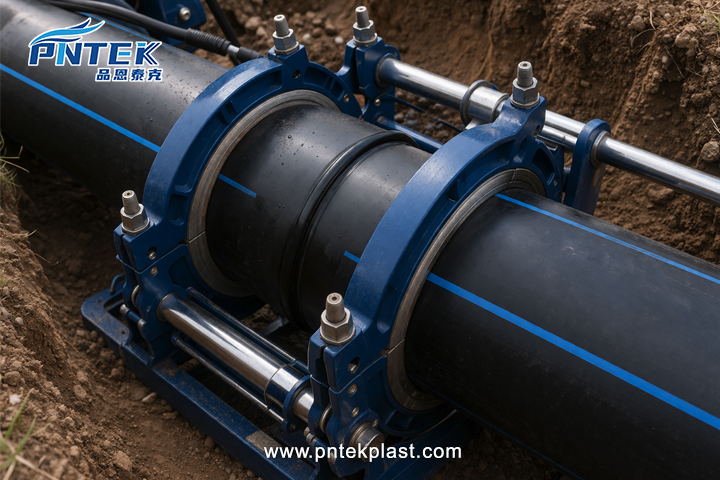
The single biggest reason to choose HDPE is the joining method. HDPE pipes are joined by heat fusion, which melts the pipe ends together to form one continuous, monolithic piece of plastic. The joint is as strong as the pipe itself and will not leak. PVC relies on gaskets or solvent cement, which create weak points in the line that can fail over time. For water utilities, these leaky joints are a massive source of water loss. Second is flexibility. HDPE’s flexibility allows it to be installed with trenchless technology like horizontal directional drilling (HDD). This means you can install a pipeline under a river or a busy road without digging a huge trench. This saves an enormous amount of time and money on excavation and restoration. These advantages provide long-term value that far outweighs any small initial difference in material cost.
Key Advantages of HDPE vs. PVC
| Feature | HDPE | PVC |
|---|---|---|
| Joint Integrity | Heat Fusion (100% leak-proof) | Gaskets or Glue (potential leak points) |
| Installation | Flexible, perfect for trenchless methods | Rigid, requires open-trench digging |
| Durability | Absorbs impact and ground movement | Brittle, can crack under stress |
| Long-Term Cost | Lower due to no leakage and less maintenance | Higher due to water loss and joint repairs |
Can you glue HDPE to PVC?
You need to connect a new HDPE pipe to an existing PVC line. You have PVC glue on hand, but are unsure if it will work. Using the wrong joining method could lead to a major leak.
No, you absolutely cannot glue HDPE to PVC. HDPE’s chemical properties prevent any solvent cement (glue) from bonding to its surface. To join the two materials, you must use a mechanical connection like a flange assembly or a special transition coupling.
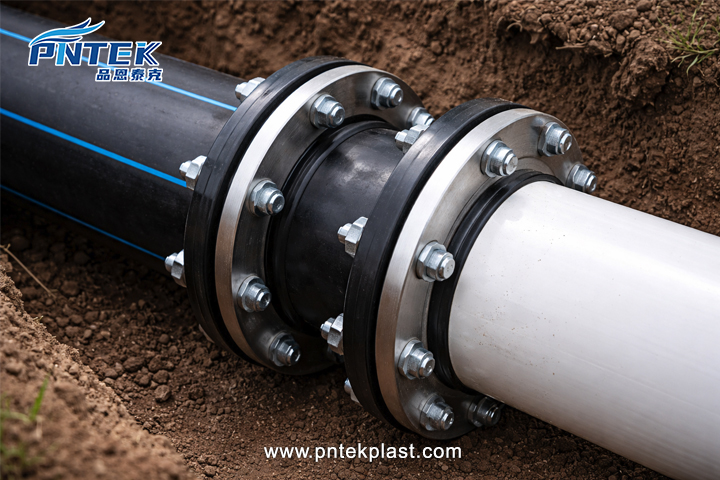
The reason you can’t glue HDPE is the same reason it’s so resistant to chemicals. Its molecular structure is very stable and non-polar, which means solvents just slide off the surface without affecting it. PVC glue works by chemically melting the surface of the PVC so it fuses together. This process does not work on HDPE. The only correct and reliable way to connect these two different materials is with a mechanical fitting. The most common method is using flanges. We butt-fuse an HDPE flange adapter (also called a stub end) to the HDPE pipe. You then glue a PVC flange onto the PVC pipe. Finally, you bolt the two flanges together with a rubber gasket in between to create a watertight seal. It’s a simple, strong, and secure method that we supply fittings for all the time.
Components for an HDPE-to-PVC Flange Connection
| Component | Function | Material |
|---|---|---|
| HDPE Stub End | Fuses to the HDPE pipe to provide a flanged face | HDPE |
| Steel Backing Ring | Slides over the stub end to provide bolting strength | Galvanized or Stainless Steel |
| PVC Flange | Glued onto the PVC pipe | PVC |
| Gasket | Creates a seal between the two flange faces | Rubber (e.g., EPDM) |
Conclusion
The difference between PE80 and PE100 is strength, with PE100 being superior. HDPE is tougher and more flexible than PVC, joined by leak-proof fusion, and must be connected mechanically.
Post time: Mar-25-2026


