
You rely on a PVC ball valve for a critical shutoff, but one day it leaks or breaks. Now your project is on hold, your client is unhappy, and you have to deal with costly water damage and repairs.
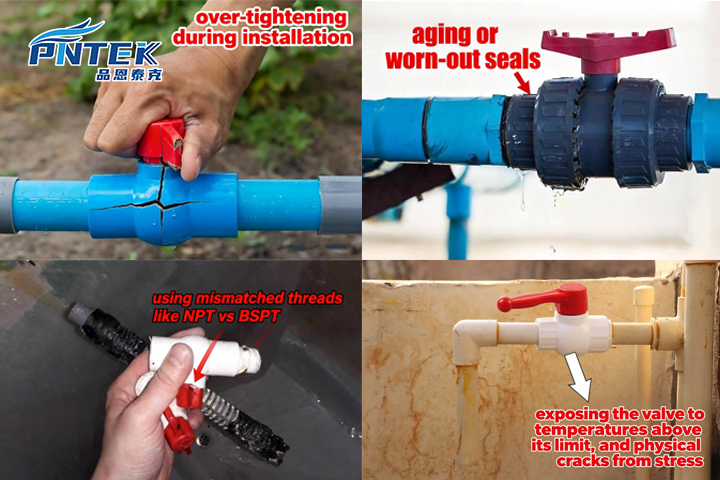
PVC ball valves typically fail from five main causes: over-tightening during installation, aging or worn-out seals, using mismatched threads like NPT vs BSPT, exposing the valve to temperatures above its limit, and physical cracks from stress.
When I talk to my partner Budi, we often discuss troubleshooting issues his clients face in the field. A leaking valve might seem like a small problem, but it can be a sign of a much bigger issue in the system design or installation process. Understanding why a valve fails is the key to preventing it from happening again. It is about more than just replacing a broken part; it is about building systems that are reliable for the long term. Let’s look at the most common reasons a PVC ball valve might let you down.
What are common problems with PVC ball valves?
You try to tighten a fitting into your new valve, and you hear a faint crack. The valve now has a hairline fracture at the port, making it completely useless before it is even installed.
The most common physical problems are cracked ports from over-tightening, broken handles from using too much force, and leaks from the stem. These are often caused by incorrect installation techniques rather than a faulty valve.
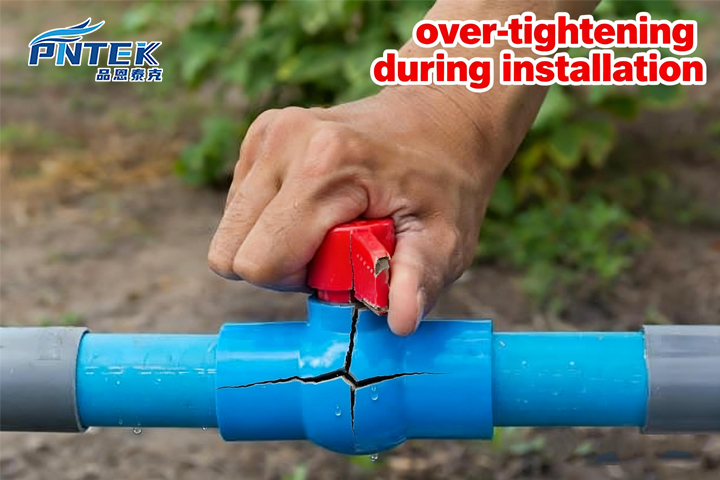
This is probably the most frequent and frustrating failure I hear about. A PVC valve body is strong, but it is still plastic. When you try to tighten a metal threaded pipe or fitting into a female PVC thread, it is very easy to use too much force. The sharp metal threads act like a wedge, putting immense outward pressure on the valve body. This leads to a crack starting at the port. My advice is always to tighten by hand first, and then use a wrench for only one or two more turns. The seal is made by the thread sealant, not by brute force. Over-tightening a valve does not create a better seal; it just creates a broken valve.
Cause & Prevention: Physical Damage
| Problem | Common Cause | How to Prevent |
|---|---|---|
| Cracked Port | Over-tightening a threaded fitting. | Hand-tighten, then use a wrench for 1-2 turns only. |
| Broken Handle | Using a wrench or “cheater bar” on the handle. | If the valve is hard to turn, check for debris, don’t just apply more force. |
| Stripped Threads | Forcing mismatched threads together. | Always confirm thread type (NPT vs. BSPT) before installation. |
What causes a PVC valve to fail over time?
Your system has been running perfectly for years, but now a valve has started a slow drip from the handle. The leak is small, but it shows the valve is beginning to fail from the inside.
Over time, the flexible seals inside the valve are the most likely point of failure. The EPDM or NBR O-rings on the stem and the PTFE seats around the ball can harden, shrink, or crack with age.
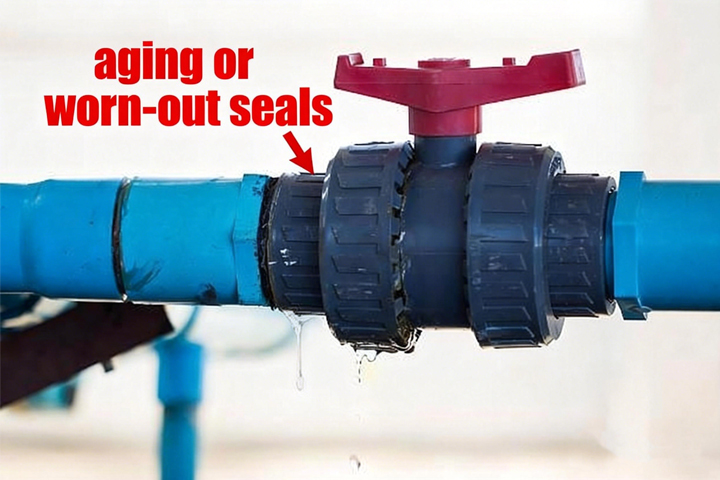
Every ball valve has a set of internal seals that do the real work. Two small O-rings around the valve stem prevent water from leaking out around the handle. Two larger, ring-shaped seats create the seal around the ball itself when the valve is closed. These seals are typically made from materials like EPDM rubber or PTFE. While very durable, they are not permanent. Continuous exposure to chemicals in the water, like chlorine, can cause them to become hard and brittle. UV light from the sun can also degrade them. Over many years of opening and closing, they can also simply wear down. This is a normal part of the valve’s life cycle. For critical applications, it is good practice to plan for valve replacement as part of long-term maintenance.
What causes ball valve failure during installation?
You have connected all your pipes, but one connection has a stubborn leak. You used plenty of thread tape, but the water still finds a way out, dripping constantly from the threads.
The most common installation mistake that causes immediate failure is a thread mismatch. Trying to connect an NPT threaded fitting to a BSPT valve (or vice versa) will create a faulty seal that is guaranteed to leak.
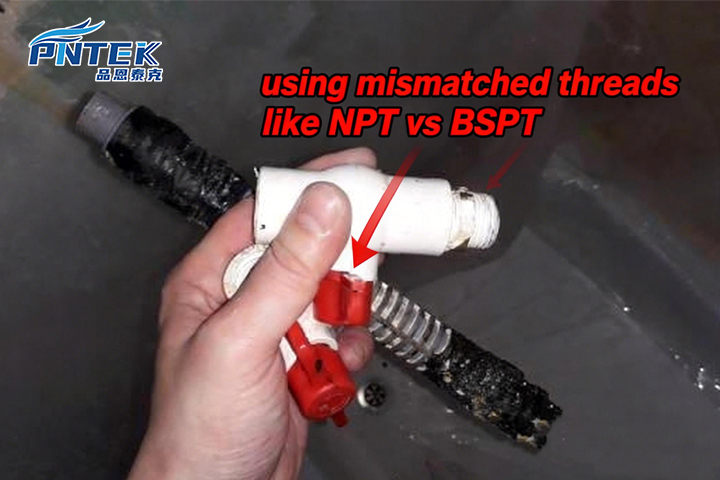
As Budi and I have discussed for the Indonesian market, you often see both NPT and BSPT standards. They look very similar, but they are not compatible. NPT threads have a 60-degree angle, while BSPT threads have a 55-degree angle. If you try to screw them together, they will cross-thread and bind. You are not creating a proper seal; you are just damaging the threads on both parts. No amount of thread sealant can fix this fundamental mismatch. The water will always find a path through the gaps. Before any installation, you must confirm that the male thread and the female thread are the same standard. This single check can prevent one of the most common and completely avoidable causes of leaks. This is a small detail that makes a huge difference.
What is the most common cause of valve failure?
A valve suddenly warps and starts leaking badly, even though it was installed correctly. The system pressure is normal, and there’s no visible damage, leaving you confused about the cause of the sudden failure.
The single most common cause of catastrophic PVC valve failure is exceeding its temperature limit. Using a standard PVC ball valve in a hot water line will cause it to soften, deform, and fail quickly.
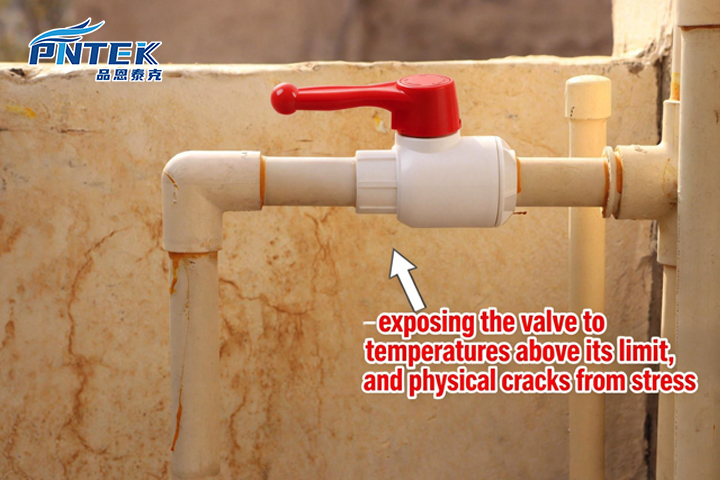
This is a critical safety issue. Standard PVC is an excellent material, but it has a clear limitation: heat. It should never be used in applications where the temperature will exceed 60°C (140°F). Above this temperature, the material begins to soften like hard cheese left in the sun. A valve that was rated for 16 bar of pressure at room temperature might only be able to handle a fraction of that before it starts to deform. The internal ball can warp out of its round shape, and the body of the valve can bulge. Once this happens, the seals can no longer make contact correctly, leading to major leaks. If your application involves hot water, you must use a material designed for it, like CPVC. This is not a suggestion; it is a rule for a safe and reliable system.
Conclusion
Prevent PVC valve failure by tightening correctly, matching threads (NPT/BSPT), respecting the 60°C temperature limit, and planning for seal aging. Proper installation and application are key to a long-lasting, leak-free system.
Post time: Jan-11-2026


