
You need a reliable source for PVC ball valves, but importing from China seems full of risks. You worry about customs delays, non-compliant products, and disruptions that could hurt your business and your reputation.
Yes, Chinese PVC ball valves are exported to Indonesia every day. The process is straightforward when you partner with an experienced manufacturer who understands Indonesia’s import regulations, shipping logistics, and critical product standards like SNI.
This is a question I discuss often with my partners in Jakarta and Surabaya. For a purchasing manager like Budi, the idea of importing can seem complicated. I understand the concern. It’s not just about getting a good price. It’s about making sure the products arrive on time, pass customs without any issues, and are suitable for the projects your customers are working on. With nearly 20 years of experience shipping our valves to Southeast Asia, I can help you navigate this process smoothly. Let’s break down the most common questions you might have.
Do Chinese PVC Ball Valve Manufacturers Provide SNI Certification?
Your projects require SNI-certified products, and you’re afraid of importing valves that can’t be legally sold. This uncertainty can stop you from accessing better quality or more cost-effective suppliers from China.
Most Chinese manufacturers do not hold SNI certification directly, as it is an importer-driven process. However, a good manufacturing partner will fully support your company in obtaining it by providing all technical documents, samples, and factory access for audits.
This is a very important technical point. The SNI certification is typically registered under the name of the Indonesian importing company, not the foreign factory. My role as your manufacturing partner is to make the process as easy as possible for you. We don’t just sell you a product; we help you meet your market’s legal requirements. When you start the SNI application process, we are ready to support you. We will provide all the necessary technical files, including product drawings, material specifications confirming our use of 100% virgin PVC, and our own internal quality control reports. Furthermore, we are fully prepared to welcome auditors from the Indonesian certification body to our factory in Ningbo. Our ISO 9001 quality management system gives them the confidence that our production is consistent and well-documented. It is a team effort, and we are committed to being a reliable part of your team.
How Long Does It Take to Ship PVC Ball Valves from China to Indonesia?
You need to keep your warehouse stocked, but unpredictable shipping times can cause stockouts and lost sales. Not knowing the real lead time makes it impossible to plan your inventory effectively and meet customer demand.
Sea freight from a major port like Ningbo to Jakarta takes about 10-15 days. However, you should plan for a total lead time of 30-45 days, which includes production, booking, port handling, and customs clearance.
For a supply chain expert like you, Budi, knowing the complete timeline is critical. The time on the water is only one part of the journey. Based on my experience shipping countless containers to Indonesia, here is a realistic breakdown of the entire process from order to delivery.
| Process Step | Typical Duration (Days) | Notes |
|---|---|---|
| Production Time | 15 – 25 | Depends on order size and if we have stock. I always confirm this upfront. |
| Inland & Port Formalities | 3 – 5 | Transporting the container from our factory to Ningbo port and clearing export customs. |
| Ocean Freight (Sea Time) | 10 – 15 | The time the vessel is on the water from Ningbo to Jakarta or Surabaya. |
| Destination & Customs | 5 – 7 | Unloading at the destination port and clearing Indonesian import customs. |
| Total Estimated Lead Time | 33 – 52 | Planning for a 45-day cycle is a safe and reliable strategy. |
Because we have long-term relationships with freight forwarders who specialize in the Southeast Asia route, we can often secure space on vessels quickly and avoid common delays.
Are Chinese PVC Ball Valves Suitable for Indonesia’s Water System?
You worry that a valve made in China might not handle Indonesia’s hot climate or specific water conditions. A brittle, cracked valve is not just a leak; it’s a failure that can damage your reputation.
Absolutely. High-quality Chinese PVC ball valves are perfect for Indonesia’s environment, provided they are made correctly. The key is to use 100% virgin PVC with UV stabilizers and durable EPDM seals to withstand tropical sun and water conditions.
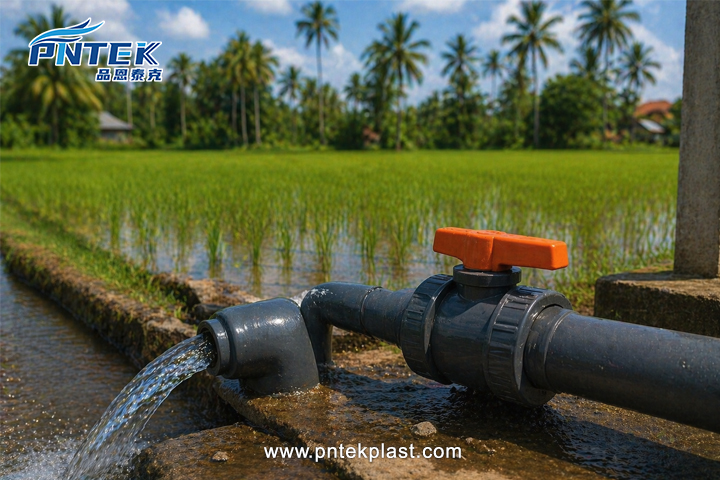
This is an excellent question because not all PVC valves are created equal. A generic valve will fail quickly in Indonesia. Our products are designed with your specific environment in mind. The first and most critical feature is UV Resistance. The intense tropical sun will degrade standard PVC, making it brittle. That is why our PVC raw material formula includes special UV-inhibiting additives. This ensures our valves maintain their strength and durability even after years of outdoor exposure in irrigation or construction projects. Second, our valves are built for performance. We only use 100% virgin PVC, which gives them a higher pressure rating and greater impact strength than cheaper valves made with calcium carbonate fillers. For the internal seals, we use high-grade EPDM O-rings. These are far more durable than the standard rubber seals used by some low-cost factories, providing a reliable, long-term seal against leaks at the stem and unions.
China vs Local Indonesia PVC Ball Valve Suppliers?
Buying from a local supplier in Indonesia seems easier and faster. But you often face higher prices, inconsistent quality, and a limited selection, which restricts your company’s ability to compete and grow.
Local suppliers offer convenience for small orders, but direct import from a Chinese manufacturer gives you major cost advantages, superior quality consistency, and access to a much wider range of products, especially for bulk purchasing.
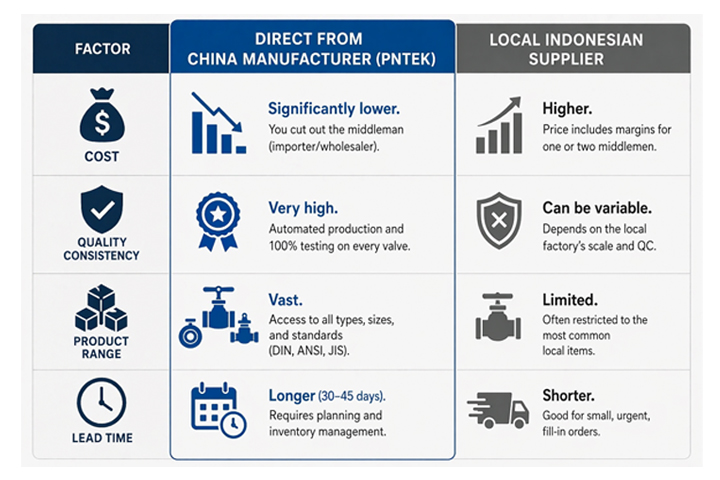
This is a strategic choice every purchasing manager must make. While local suppliers play an important role, partnering directly with a manufacturer like Pntek offers powerful advantages for a growing distribution business.
| Factor | Direct from China Manufacturer (Pntek) | Local Indonesian Supplier |
|---|---|---|
| Cost | Significantly lower. You cut out the middleman (importer/wholesaler). | Higher. Price includes margins for one or two middlemen. |
| Quality Consistency | Very high. Automated production and 100% testing on every valve. | Can be variable. Depends on the local factory’s scale and QC. |
| Product Range | Vast. Access to all types, sizes, and standards (DIN, ANSI, JIS). | Limited. Often restricted to the most common local items. |
| Lead Time | Longer (30-45 days). Requires planning and inventory management. | Shorter. Good for small, urgent, fill-in orders. |
For a professional buyer like you, Budi, the benefits of direct importing are clear. By planning your purchases, you can significantly reduce your cost of goods and offer your customers a more reliable and diverse product line, giving your company a strong competitive edge in the Indonesian market.
Conclusion
Exporting from China to Indonesia is a proven, reliable process. With a partner who supports SNI, understands logistics, and engineers products for your climate, you can gain a major competitive advantage.
Post time: Apr-21-2026


