
Finding reliable PVC valve suppliers for Indonesia is a constant challenge. You face a confusing mix of factories and traders, with risks of low quality, compliance issues, and shipping delays affecting your business.
A successful sourcing strategy for Indonesia requires focusing on four key areas: verifying the supplier’s true identity, understanding SNI requirements, mastering the import documentation process, and demanding proof of material quality and testing.
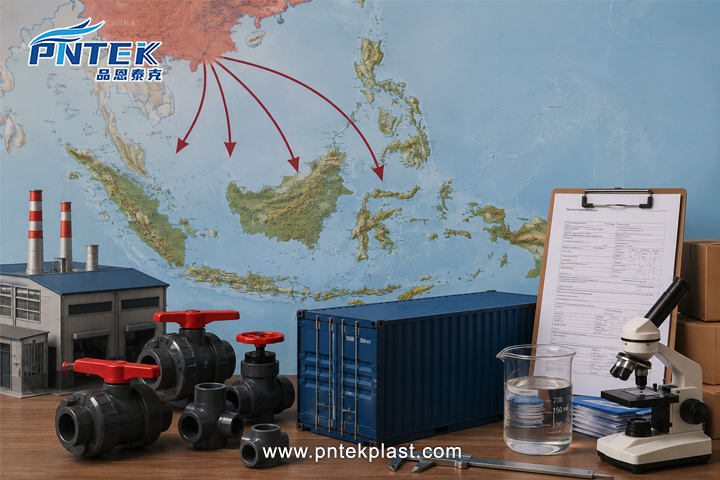
As a purchasing manager for the Indonesian market, you know that sourcing is more than just finding the lowest price. It’s about building a stable and predictable supply chain. I’ve worked with partners in Indonesia for nearly 20 years, and I’ve seen the challenges firsthand—from navigating customs at Tanjung Priok to meeting the quality demands of local contractors. This guide is my direct, manufacturer-to-buyer advice to help you build a sourcing strategy that protects your company and helps it grow. Let’s break down what you really need to know.
Who Are the Top PVC Ball Valve Suppliers Exporting to Indonesia?
You see dozens of supplier names online, but you don’t know who is a major player and who is just a small, unreliable trading company. Choosing the wrong one is a huge risk.
The “top” suppliers are not just names on a list; they are factories that demonstrate manufacturing expertise, consistent quality control, and deep experience with the Indonesian market, especially regarding logistics and standards.
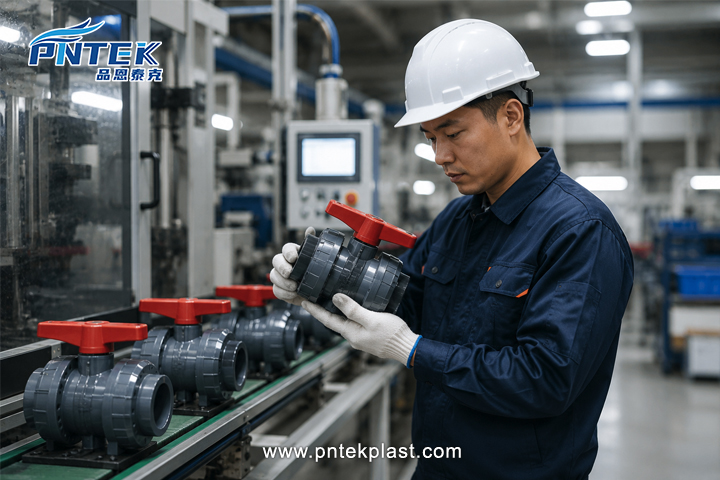
A simple “Top 10″ list is misleading because it doesn’t tell you if a supplier is right for your business. From my experience, the best suppliers for Indonesia fall into a specific category. It’s more useful to understand the types of suppliers you will encounter.
| Supplier Type | Strengths | Weaknesses |
|---|---|---|
| Large, State-Owned Enterprises | Huge capacity, can handle massive orders. | Often slow, bureaucratic, and less flexible on custom requests or private labels. |
| Small, Price-Focused Factories | Very low prices. | High risk of using cheap materials (calcium), poor quality control, no export experience. |
| Pure Trading Companies | Good at communication and may offer a wide range of products. | No control over quality, add cost, communication about technical details is slow. |
| Specialized, Integrated Factories (like Pntek) | Own their factory (quality control), have an expert export team (smooth logistics), understand your market (SNI, Form E). | Prices are not the absolute lowest, as they are based on 100% virgin material. |
The best partner for a professional buyer like you is an integrated factory. We combine the direct manufacturing control you need with the expert trading and logistics services that make your job easier. We are built to be a reliable, long-term partner, not just a one-time seller.
How Do I Import PVC Ball Valves from China to Indonesia?
You worry that a simple paperwork mistake could cause your shipment to be stuck in customs for weeks. These delays cost money in storage fees and ruin your inventory and delivery schedules.
A smooth import process depends on your supplier providing four key documents perfectly: the Commercial Invoice, Packing List, Bill of Lading, and the crucial Certificate of Origin (Form E) for tax savings.
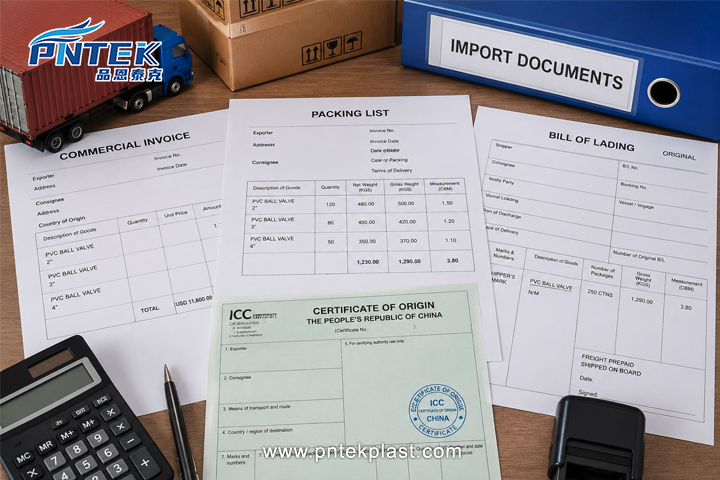
After we have manufactured your high-quality valves, my team’s most important job is to ensure you have zero problems with Indonesian customs. Having the correct documents is not just a formality; it is essential for a fast and cost-effective import process. I’ve seen many importers face headaches because their supplier was careless with this step. Here is a breakdown of the documents my team prepares for every shipment to Indonesia:
- Commercial Invoice: This details the buyer, seller, products, and value. Indonesian customs (Bea Cukai) use this to calculate the import duties and taxes (PPN and PPh). Accuracy is critical.
- Packing List: This document specifies the contents, weight, and volume of each carton and pallet. It allows customs to verify the shipment’s contents quickly.
- Bill of Lading (B/L): This is the contract with the shipping line and your proof of ownership. You need the original B/L or a telex release to claim your container at the port.
- Certificate of Origin (Form E): This is the most important document for saving you money. By certifying that the goods are made in China, it allows you to benefit from the ASEAN-China Free Trade Agreement (ACFTA), often reducing your import tariff to 0%. A supplier who doesn’t understand this costs you money.
We handle this process daily. We ensure every detail is correct so your shipment clears customs without delay.
Do I Need PVC Ball Valves with SNI Certification for the Indonesian Market?
You are unsure if SNI certification is mandatory for PVC ball valves. Selling a non-compliant product could lead to it being rejected for major projects or, worse, facing regulatory penalties.
While SNI certification is mandatory for PVC pipes, it is not yet mandatory for PVC ball valves. However, for government tenders and large construction projects, providing valves that are manufactured to SNI standards is a major commercial advantage.
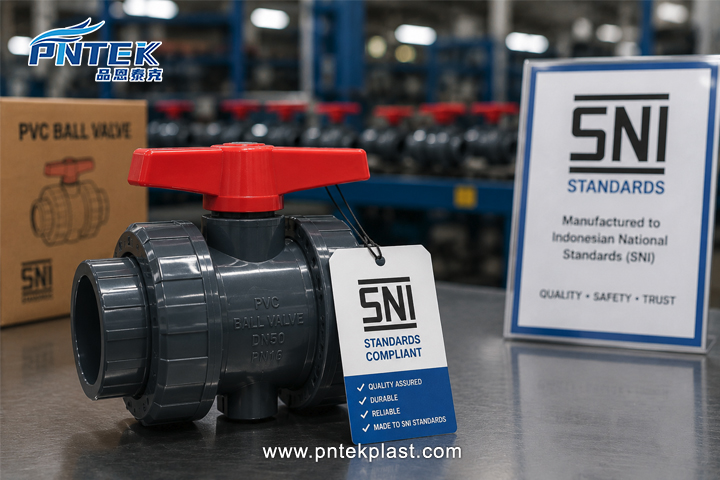
This is an excellent question that shows your deep understanding of the local market, Budi. The SNI situation for valves is a common point of confusion. Here is the reality on the ground: the government does not legally require every PVC ball valve sold in Indonesia to have an official SNI stamp. However, the market is moving in that direction. Big contractors and government projects (PU) have started demanding products that meet the technical specifications of the relevant SNI standard (like SNI 06-0135-1987 for PVC valves). They want proof of quality and performance. A supplier who just says “it’s not mandatory” is missing the point. A smart supplier understands that your customers need confidence. At Pntek, even though the certification isn’t mandatory, we manufacture and test our valves to meet or exceed the performance requirements outlined in the SNI standards. We can provide you with detailed factory test reports and material data sheets that you can show to your customers. This proves the quality and helps you win those important projects. It’s about giving you the tools to compete effectively.
What Should I Check Before Choosing a PVC Valve Supplier?
All the supplier websites and brochures look professional. It’s hard to tell who is truly a high-quality manufacturer and who is just good at marketing, leaving you at risk of making a bad choice.
Before choosing a supplier, you must verify four things: their factory status with a live video tour, their material quality with a 100% virgin PVC guarantee, their QC process with proof of 100% pressure testing, and their experience with Indonesia.
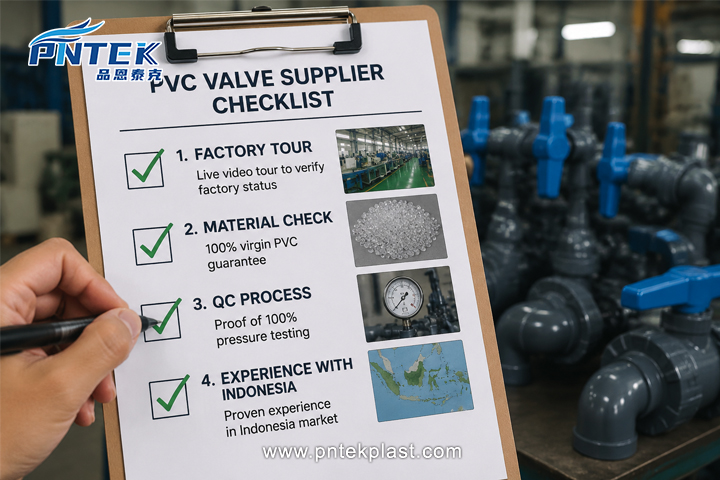
As a manufacturer, I know what separates a reliable factory from a risky one. You need to be a detective and demand proof. Do not just trust what they write; make them show you. Here is the practical checklist I would use if I were in your position.
My Personal Supplier Verification Checklist
- 1. Verify They Are a Real Factory: Don’t just ask “Are you a factory?”. Instead, say: “I need to schedule a live video call with you tomorrow to see your injection molding machines, your assembly line, and your pressure testing area.” A real factory will be proud to show you. A trading company will make excuses.
- 2. Verify the Material: Do not accept vague terms like “high quality plastic.” Ask for a written guarantee in the contract that they use 100% Virgin PVC Raw Material with no calcium carbonate fillers. Ask for the material data sheet from their raw material supplier. Low prices almost always mean they are using cheap, brittle filler material.
- 3. Verify the Quality Control: Do not accept “we have a QC department.” Ask them: “Do you pressure test 100% of your valves before packing, or only a small sample?” Demand proof. A good factory can send you a video of your actual order being tested, valve by valve.
- 4. Verify Their Market Experience: Ask specific questions about your market. “Can you provide a Form E for Indonesia? Are you familiar with SNI standards for valves? What is the most popular valve specification for the Indonesian market?” Their answers will quickly reveal if they have real experience or are just guessing.
A good partner will welcome these questions. A supplier who avoids them is hiding something.
Conclusion
A successful Indonesia sourcing strategy means finding a partner, not just a seller. Focus on verifying quality, understanding local rules, and working with a true manufacturer who is invested in your success.
Post time: May-09-2026


