
You need to install a PVC ball valve, but a bad glue job can cause leaks. This simple mistake can ruin your project, waste expensive materials, and damage your reputation with your clients.
To glue a PVC ball valve, apply purple primer to the pipe end and inside the valve socket. Quickly follow with a generous layer of PVC cement on both parts. Insert the pipe fully into the socket with a quarter-turn twist and hold it firmly for 30 seconds.
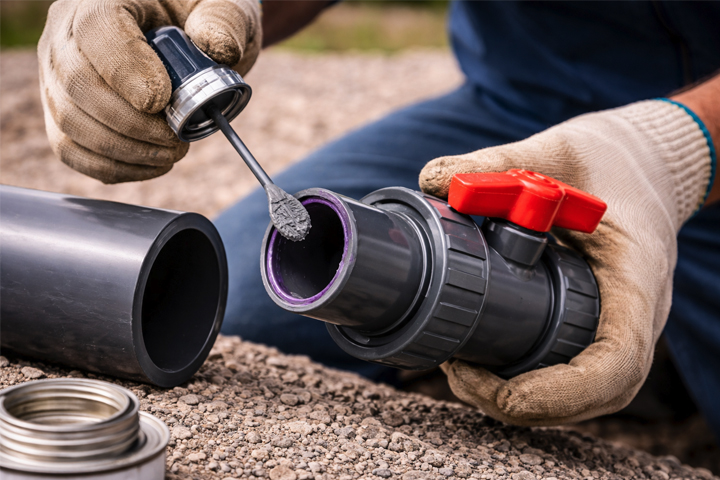
Over the years, I’ve seen countless installations, and a perfectly good valve can fail because of one bad joint. It’s a common challenge that purchasing managers like Budi and his installation teams face every day. The process itself is simple, but every single step is critical for creating a bond that will last for decades. Skipping one step, or rushing the process, is the difference between a leak-proof system and a call-back. Let’s break down the details to ensure every connection you make is perfect.
Can PVC ball valves leak?
You trust PVC ball valves for a reliable shutoff. But a slow, hidden drip can go unnoticed for weeks, causing water damage or critical system pressure loss that is frustrating and costly to find.
Yes, PVC ball valves can absolutely leak. Leaks most often happen at the solvent-welded joints due to improper gluing. They can also leak from the valve stem packing over time, or fail internally if the seals are damaged.
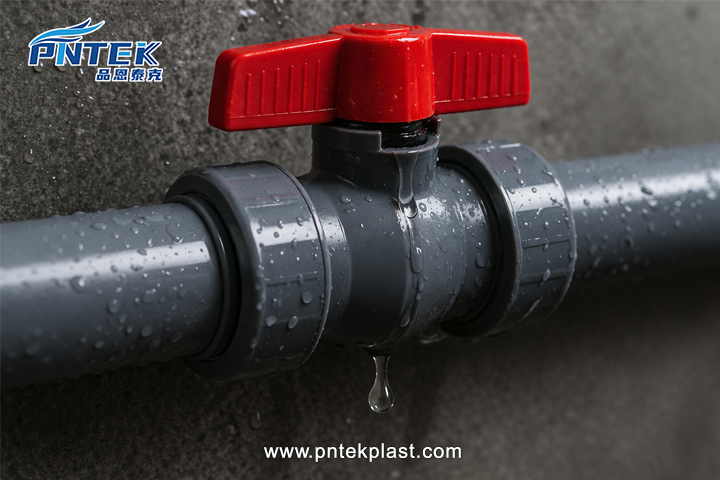
When a valve leaks, it almost always comes down to one of three weak points. The most common one I see is the joint itself. This is nearly always an installation error. Maybe the installer didn’t use primer, or didn’t apply enough cement, or failed to hold the joint together long enough for the chemical weld to set. At Pntek, we machine our valve sockets with very tight tolerances to help ensure a snug fit, which helps reduce these errors. The second leak point is the stem. The O-rings that seal the handle can wear out from frequent use or degrade from chemicals. Our valves use high-quality EPDM O-rings and often have a double-seal design to provide extra security against stem leaks. The third issue is a leak through the valve when it’s closed. This happens when debris like sand gets caught and scratches the internal seats, or the seats simply wear out on a low-quality valve.
| Leak Location | Common Cause | Prevention/Solution |
|---|---|---|
| Glued Joint | Improper installation (no primer, etc.) | Follow correct gluing procedure; use quality valves |
| Valve Stem | Worn O-rings; frequent use | Use valves with durable EPDM/Viton seals |
| Through the Ball | Scratched seats from debris; wear & tear | Flush lines before install; use quality valves |
Is PVC 100% waterproof?
You assume that since PVC is plastic, it is completely waterproof. But this assumption can be dangerous if you don’t understand its limitations, leading you to create systems that could eventually fail.
The solid PVC material itself is 100% waterproof and non-porous. However, a finished PVC system is only as waterproof as its weakest point—the solvent-welded joints. A perfectly made joint is absolutely required to create a 100% waterproof system.
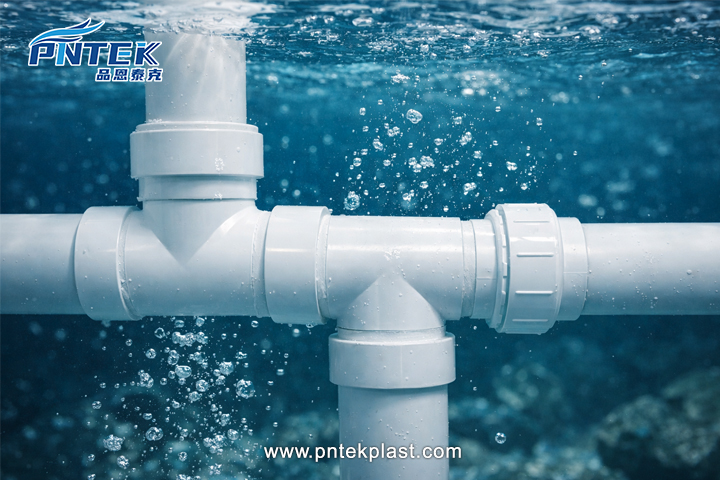
This is a really important distinction between the material and the system. You can take a piece of PVC pipe and leave it submerged in water for decades, and the material itself will not absorb water or degrade. It’s a solid, non-porous polymer. The vulnerability is never the pipe or fitting material, but the connections between them created by your team. The solvent cement process is technically a chemical weld. The primer cleans the surface and the cement temporarily melts the two pieces of plastic, fusing them into one. If that weld is incomplete because of dirt, lack of cement, or not holding it firmly, it can create a tiny, microscopic channel. This channel might not leak at low pressure, but once the system is fully pressurized, water will find a way through. For Budi’s teams in Indonesia, it’s also important to remember that the warm, humid climate affects cure times. The joint needs to sit undisturbed long enough to gain full strength before pressure is applied.
Why do PVC ball valves get stuck?
You need to shut off the water in an emergency, but the valve handle won’t budge. A stuck valve is completely useless when you need it most and can turn simple maintenance into a major project.
PVC ball valves usually get stuck from infrequent use, which allows mineral deposits to build up between the ball and its seals. Over-tightening the union nuts on a true union valve can also cause it to bind and become difficult to turn.
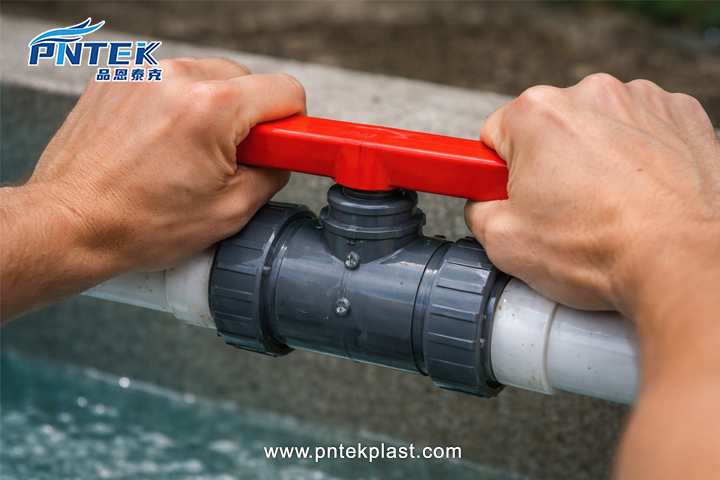
This is the number one service complaint about ball valves of any material. The most common reason is simple—the valve just doesn’t get used. Water, especially hard water, contains dissolved minerals like calcium. When a valve sits in the same open position for a year, these minerals can slowly precipitate and build up between the ball and the PTFE seats, acting like a cement. The easiest way to prevent this is to “exercise” the valve by turning it off and on once every few months. This breaks up any minor buildup. Another common cause, specifically for true union valves, is over-tightening. The large union nuts are there to seal the valve body using O-rings. They only need to be hand-tight plus a small turn with a wrench. When an installer cranks down on them with a huge wrench, it squeezes the whole valve body, compressing the ball against the seats and making it extremely difficult to turn. Our Pntek valves are designed to seal perfectly without this kind of excessive force.
How to know if a PVC valve is bad?
A failing valve can look perfectly fine from the outside. Not knowing the subtle warning signs can lead to a sudden and catastrophic failure, causing property damage and disrupting service for your customers.
A PVC valve is bad if it leaks from its joints or stem, fails to completely stop the water flow when closed, or if the handle is impossible to turn. Any visible cracks on the valve body are also a clear sign it needs immediate replacement.
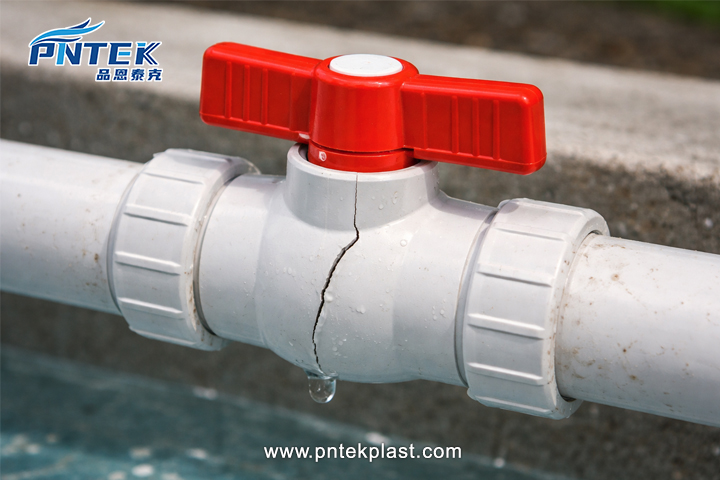
It’s important that your teams know what to look for during routine inspections. A few simple checks can prevent a big problem later. First, do a careful visual inspection. Look for any hairline cracks, especially around the sockets where the pipe is inserted. These are caused by stress and are a sign of impending failure. Also, check for any significant discoloration, which might mean the PVC is degrading from chemical exposure or UV light. Next, perform a functional test. Close the valve and see if water still trickles past. This “leak-through” means the internal seats are damaged. Check for any drips from the handle stem or the glued connections. Finally, test the action of the handle. It should be firm but turn smoothly. If it’s completely frozen or so stiff you risk breaking the handle, it’s unreliable and should be replaced. A quality valve from a trusted manufacturer like Pntek will have thicker walls and a more robust stem design, making these failures far less likely.
Conclusion
Gluing a PVC valve correctly is critical for a leak-proof system. Recognize that valves can leak or get stuck, and know the visual signs of a bad valve to prevent future failures.
Post time: Mar-26-2026


